Available in: Open/CE, BE, SE, SE+, Ultimate/EE
The module lifecycle stage: Experimental
The module has requirements for installation
Before enabling the module, you need to allow the use of experimental modules in the deckhouse ModuleConfig. To do this, set the allowExperimentalModules parameter to true.
How to explicitly enable or disable the module…
You may explicitly enable or disable the module in one of the following ways:
-
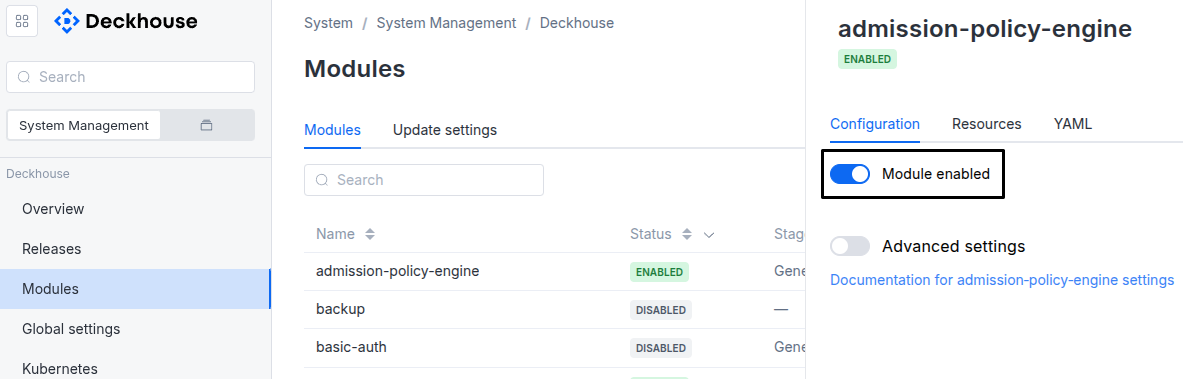
Via Deckhouse web UI. In the “System” → “System Management” → “Deckhouse” → “Modules” section, open the
adaptive-resource-managementmodule and enable (or disable) the “Module enabled” toggle. Save changes.Example:
-
Via Deckhouse CLI (d8).
Use the d8 system module enable command for enabling, or d8 system module disable command for disabling the module (you need Deckhouse CLI (d8), configured to work with the cluster).
Example of enabling the module:
d8 system module enable adaptive-resource-management -
Using ModuleConfig
adaptive-resource-management.Set
spec.enabledtotrueorfalsein ModuleConfigadaptive-resource-management(create it if necessary).Example of a manifest to enable module
adaptive-resource-management:apiVersion: deckhouse.io/v1alpha1 kind: ModuleConfig metadata: name: adaptive-resource-management spec: enabled: true
You can configure the module in one of the following ways:
-
Via Deckhouse web UI.
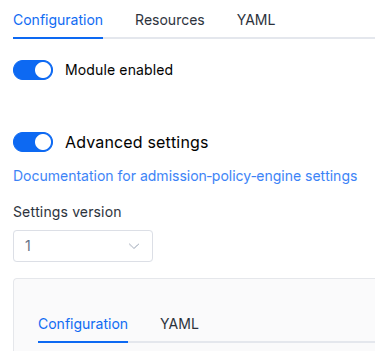
In the “System” → “System Management” → “Deckhouse” → “Modules” section, open the
adaptive-resource-managementmodule and enable the “Advanced Settings” toggle. Fill in the required fields in the “Configuration” tab or specify the module settings in YAML format on the “YAML” tab, without the top-levelsettingskey. Save the changes.Example:
You can also edit the ModuleConfig object
adaptive-resource-managementon the “YAML” tab in the module settings window (“System” → “System Management” → “Deckhouse” → “Modules”, open the moduleadaptive-resource-management) by specifying the schema version in thespec.versionparameter and the necessary module parameters in thespec.settingssection. -
Via Deckhouse CLI (d8) (requires Deckhouse CLI (d8) configured to work with the cluster).
Edit the existing ModuleConfig
adaptive-resource-management(for more details on configuring Deckhouse Platform, see the documentation) by executing the following command:d8 k edit mc adaptive-resource-managementMake the necessary changes in the
spec.settingssection. If necessary, specify the schema version in thespec.versionparameter. Save the changes.You can also create a manifest file for ModuleConfig
adaptive-resource-managementusing the example below. Fill in thespec.settingssection with the required module parameters. If necessary, specify the schema version in thespec.versionparameter.Apply the manifest using the following command (indicate the manifest file name):
d8 k apply -f <FILENAME>Example of a manifest for ModuleConfig
adaptive-resource-management:apiVersion: deckhouse.io/v1alpha1 kind: ModuleConfig metadata: name: adaptive-resource-management spec: version: 1 enabled: true settings: # Module parameters from the "Parameters" section below.
Requirements
To the Kubernetes version: 1.31 and above.
To the Deckhouse Platform version: 1.71 and above.
To the versions of other modules:
-
vertical-pod-autoscaler: any version.
Parameters
Schema version: 1
-
-
objectsettings.autovpa
AutoVPA controller settings.
Is a utility that helps identify resource requests and limits for containers running in a cluster using VPA recommendations.
Default:
{}-
booleansettings.autovpa.enabled
Enables the AutoVPA controller.
Namespaces with the
kube-ord8-name prefix are never managed by AutoVPA, regardless of this setting.Default:
false -
objectsettings.autovpa.namespaceLabelSelector
A standard Kubernetes LabelSelector that selects namespaces for AutoVPA to manage.
When
onlySpecialLabelis also true, the resulting namespace list is the union of namespaces matching this selector and namespaces with theautovpa.deckhouse.io/enabled: "true"label.When
onlySpecialLabelis false, only namespaces matching this selector are managed.-
array of objectssettings.autovpa.namespaceLabelSelector.matchExpressionsA list of label selector requirements.
-
stringsettings.autovpa.namespaceLabelSelector.matchExpressions.keyThe label key that the selector applies to.
-
stringsettings.autovpa.namespaceLabelSelector.matchExpressions.operatorRepresents a key’s relationship to a set of values.
Allowed values:
In,NotIn,Exists,DoesNotExist -
array of stringssettings.autovpa.namespaceLabelSelector.matchExpressions.valuesAn array of string values. Required for
InandNotInoperators.
-
-
objectsettings.autovpa.namespaceLabelSelector.matchLabelsA map of key-value label pairs. A namespace must have all these labels to be selected.
-
-
objectsettings.autovpa.nodeSelector
The same as in the Pods’
spec.nodeSelectorparameter in Kubernetes.If the parameter is omitted or
false, it will be determined automatically. -
booleansettings.autovpa.onlySpecialLabel
When true, AutoVPA will manage namespaces that have the
autovpa.deckhouse.io/enabled: "true"label.When
namespaceLabelSelectoris also set, the resulting namespace list is the union of both: namespaces matching the selector and namespaces with the special label.When false and
namespaceLabelSelectoris not set, AutoVPA manages all namespaces except those with thekube-ord8-name prefix. When false andnamespaceLabelSelectoris set, only namespaces matching the selector are managed; the special label is ignored.Default:
false -
array of objectssettings.autovpa.tolerations
The same as in the Pods’
spec.tolerationsparameter in Kubernetes.If the parameter is omitted or
false, it will be determined automatically.-
stringsettings.autovpa.tolerations.effect
-
stringsettings.autovpa.tolerations.key
-
stringsettings.autovpa.tolerations.operator
-
integersettings.autovpa.tolerations.tolerationSeconds
-
stringsettings.autovpa.tolerations.value
-
-
-