Available with limitations in: Open/CE, Core, BE, SE, SE+
Available without limitations in: Ultimate/EE
Included in extensions: Advanced Infrastructure Security
The module lifecycle stage: General Availability
The module has 4 alerts.
The module is enabled by default in the following bundles: Default, Managed.
The module is disabled by default in the Minimal bundle.
How to explicitly enable the module...
You may explicitly enable or disable the module in one of the following ways:
-
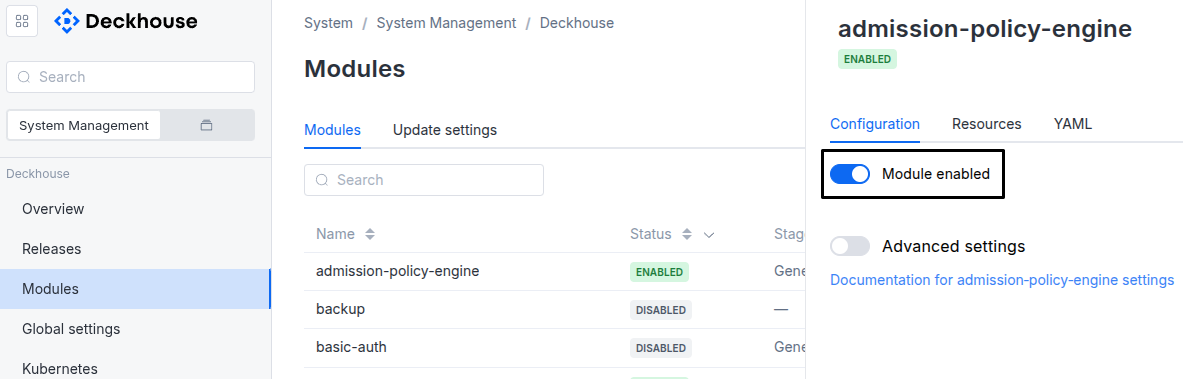
Via Deckhouse web UI. In the “System” → “System Management” → “Deckhouse” → “Modules” section, open the
admission-policy-enginemodule and enable (or disable) the “Module enabled” toggle. Save changes.Example:
-
Via Deckhouse CLI (d8).
Use the d8 system module enable command for enabling, or d8 system module disable command for disabling the module (you need Deckhouse CLI (d8), configured to work with the cluster).
Example of enabling the module:
d8 system module enable admission-policy-engine -
Using ModuleConfig
admission-policy-engine.Set
spec.enabledtotrueorfalsein ModuleConfigadmission-policy-engine(create it if necessary);Example of a manifest to enable module
admission-policy-engine:apiVersion: deckhouse.io/v1alpha1 kind: ModuleConfig metadata: name: admission-policy-engine spec: enabled: true
How to configure the module...
You can configure the module in one of the following ways:
-
Via Deckhouse web UI.
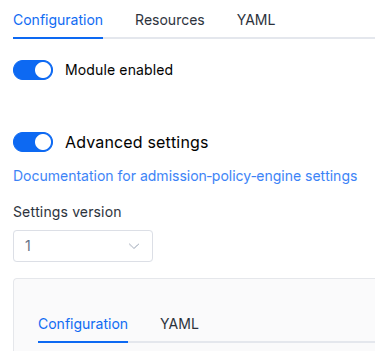
In the “System” → “System Management” → “Deckhouse” → “Modules” section, open the
admission-policy-enginemodule and enable the “Advanced Settings” switch. Fill in the required fields in the “Configuration” tab or specify the module settings in YAML format on the “YAML” tab, excluding the settings section. Save the changes.Example:
You can also edit the ModuleConfig object
admission-policy-engineon the “YAML” tab in the module settings window (“System” → “System Management” → “Deckhouse” → “Modules”, open the moduleadmission-policy-engine) by specifying the schema version in thespec.versionparameter and the necessary module parameters in thespec.settingssection. -
Via Deckhouse CLI (d8) (requires Deckhouse CLI (d8) configured to work with the cluster).
Edit the existing ModuleConfig
admission-policy-engine(for more details on configuring Deckhouse, see the documentation) by executing the following command:d8 k edit mc admission-policy-engineMake the necessary changes in the
spec.settingssection. If necessary, specify the schema version in thespec.versionparameter. Save the changes.You can also create a file with manifest for ModuleConfig
admission-policy-engineusing the example below. Fill in thespec.settingssection with the required module parameters. If necessary, specify the schema version in thespec.versionparameter.Apply the manifest using the following command (indicate the manifest file name):
d8 k apply -f <FILENAME>Example of a manifest for ModuleConfig
admission-policy-engine:apiVersion: deckhouse.io/v1alpha1 kind: ModuleConfig metadata: name: admission-policy-engine spec: version: 1 enabled: true settings: # Module parameters from the "Parameters" section below.
Parameters
Schema version: 1
- objectsettings
- objectsettings.denyVulnerableImages
Available in editions: Ultimate/EE
Trivy provider settings.
The Trivy provider prevents creation of the Pod, Deployment, StatefulSet, and DaemonSet resources with images containing vulnerabilities in namespaces labeled with
security.deckhouse.io/trivy-provider: "".Deprecated. These settings have been moved to the
operator-trivymodule. Please migrate your configuration.- array of stringssettings.denyVulnerableImages.allowedSeverityLevels
List of allowed vulnerability severity levels.
Images containing only vulnerabilities of the specified severity levels will not be blocked.
- stringElement of the array
Allowed values:
UNKNOWN,LOW,MEDIUM,HIGH,CRITICAL
- booleansettings.denyVulnerableImages.enabled
Enable the Trivy provider.
Default:
false - array of objectssettings.denyVulnerableImages.registrySecrets
List of additional Secrets for accessing private registries.
By default, the
deckhouse-registrySecret is used to download images for scanning.Default:
[]- stringsettings.denyVulnerableImages.registrySecrets.name
Required value
- stringsettings.denyVulnerableImages.registrySecrets.namespace
Required value
- stringsettings.denyVulnerableImages.storageClass
Name of the StorageClass used by the Trivy provider.
If the value is not specified, the StorageClass set in the global
settings.modules.storageClassparameter is used instead.The global
settings.modules.storageClassparameter is only applied when the module is enabled. Changing the global parameter while the module is enabled will not trigger disk re-provisioning.Warning. If you specify a value different from the current StorageClass used in the existing PersistentVolumeClaim, the disk will be re-provisioned, and all data will be deleted.
If you set it to
false,emptyDirwill be forcibly used instead of a PVC.Examples:
storageClass: ceph-ssdstorageClass: 'false'
- objectsettings.podSecurityStandards
Pod Security Standards policy settings (PSS).
- stringsettings.podSecurityStandards.defaultPolicy
Sets the default Pod Security Standards policy for all non-system namespaces:
Privileged— an unrestricted policy. Privilege escalation is possible with this policy;Baseline— a policy with minimum restrictions that prevents privilege escalation;Restricted— a policy with maximum restrictions that conforms to current best practices for securely running applications in a cluster.
By default:
Baseline— if a Deckhouse version starting with v1.55 is being installed;Privileged— if a Deckhouse version lower than v1.55 is being installed (upgrading Deckhouse in a cluster to v1.55+ does not automatically result in a default policy change).
Allowed values:
Privileged,Baseline,Restricted - stringsettings.podSecurityStandards.enforcementAction
The enforcement action to control what to do with the result of the constraint.
- Deny — Deny action.
- Dryrun — No action. It is used when debugging. Information about the event can be viewed in Grafana or in the console via
d8 k. - Warn — Same as
Dryrun. In addition to the event information, it provides some info on why that constraint would have been denied if you had setDenyinstead ofWarn.
Default:
DenyAllowed values:
Warn,Deny,Dryrun - objectsettings.podSecurityStandards.policies
Sets additional policy parameters.
- objectsettings.podSecurityStandards.policies.hostPorts
HostPort constraint settings.
- array of objectssettings.podSecurityStandards.policies.hostPorts.knownRanges
Set the range of known ports which will be allowed in a hostPort binding.
- integersettings.podSecurityStandards.policies.hostPorts.knownRanges.max
- integersettings.podSecurityStandards.policies.hostPorts.knownRanges.min