Available in: Ultimate/EE
Included in extensions: AI Inference
The module lifecycle stage: Experimental
The module has requirements for installation
The module is configured through ModuleConfig. The contract contains
platform-level settings: logging level, object storage, delivery mode, and
distribution mode. Model lists, upstreams, and user catalog imports are not
stored in ModuleConfig.
Minimal Configuration
apiVersion: deckhouse.io/v1alpha1
kind: ModuleConfig
metadata:
  name: ai-models
spec:
  enabled: true
  version: 1
  settings:
    artifacts:
      bucket: ai-models
      endpoint: https://s3.example.com
      region: us-east-1
      credentialsSecretName: ai-models-artifacts
      usePathStyle: true
Object Storage and DMCR
artifacts configures S3-compatible object storage for DMCR data, upload
staging, and module byte-path data. Every model goes through this
controller-owned preparation path regardless of source: URL, upload, or
catalog import.
DMCR (Deckhouse Model Container Registry) is the module’s internal OCI
registry. It stores prepared models as internal OCI artifacts on top of the
bucket configured in artifacts.
Credentials are provided through a Secret in d8-system:
apiVersion: v1
kind: Secret
metadata:
  name: ai-models-artifacts
  namespace: d8-system
type: Opaque
stringData:
  accessKey: "<access-key>"
  secretKey: "<secret-key>"
For a custom CA, set artifacts.caSecretName or add ca.crt to the same
Secret.
External Provider Catalog Data Services
External provider catalogs, such as Hugging Face, can contain far more entries
than the Kubernetes API should store or watch. The module therefore keeps
remote provider search/index data outside etcd. Only a model that a user or
administrator explicitly imports becomes a local Model or ClusterModel.
When external provider browse/search/import is enabled, the module requires two already provisioned data services:
- PostgreSQL-compatible database for the durable external catalog index, synchronization state, schema migration state, and import history.
- Valkey-compatible service for short-lived search cache, provider rate-limit counters, distributed locks, and temporary coordination.
ai-models does not create PostgreSQL or Valkey instances. The administrator
provides connection Secrets for existing services. Those services can be
created with DKP managed-postgres and managed-valkey modules, by a corporate
DBaaS, or by another operational process. The DKP managed modules are a
convenient provisioning option, not an architectural dependency of ai-models.
Configure the module with existing Secret names:
apiVersion: deckhouse.io/v1alpha1
kind: ModuleConfig
metadata:
  name: ai-models
spec:
  enabled: true
  version: 1
  settings:
    externalCatalog:
      enabled: true
      dataServices:
        postgresConnectionSecretName: ai-models-catalog-postgres
        valkeyConnectionSecretName: ai-models-catalog-valkey
The referenced Secrets must be in d8-system. When external catalog is
enabled, the controller readiness probe validates the Secrets and performs
bounded live probes before reporting the external catalog data services as
ready.
Recommended Secret shape:
apiVersion: v1
kind: Secret
metadata:
  name: ai-models-catalog-postgres
  namespace: d8-system
type: Opaque
stringData:
  dsn: "postgres://ai_models:<password>@postgres.example.com:5432/ai_models_catalog?sslmode=require"
  ca.crt: |-
    -----BEGIN CERTIFICATE-----
    ...
-----END CERTIFICATE-----apiVersion: v1
kind: Secret
metadata:
name: ai-models-catalog-valkey
namespace: d8-system
type: Opaque
stringData:
url: "rediss://:<password>@valkey.example.com:6379/0"
ca.crt: |-
-----BEGIN CERTIFICATE-----
...
-----END CERTIFICATE-----ca.crt is needed only when the service uses a private CA. Secret values,
provider tokens, and database passwords must not be copied into Model,
ClusterModel, events, metrics labels, or user-facing status messages.
Before synchronizing a provider source, configure safe bounds for the source:
allowed organizations, repositories, collections or tags, maximum indexed
entries, metadata-size limits, refresh interval, and refresh budget. A source
that is too broad must stay blocked with an actionable reason such as
SourcePolicyTooBroad instead of starting an unbounded provider scan.
External catalog readiness is separate from model readiness. The current controller readiness check verifies PostgreSQL connection/auth/database reachability with a temporary read/write probe, and verifies Valkey with PING, TTL read/write, lock and rate-limit key probes. Future source/status slices will project distinct reasons for PostgreSQL failures, Valkey failures, provider rate limits, invalid data-service Secrets, and source-policy violations. If PostgreSQL or Valkey is unavailable, external catalog search/import must remain unavailable or waiting; the module must not fall back to storing remote provider entries in etcd or an unbounded in-memory index.
A user flow with an external provider catalog is:
- The administrator configures data-service connections and a bounded provider source.
- The module checks PostgreSQL, Valkey, and provider/source readiness.
- A user searches or previews remote provider entries.
- The user explicitly imports one entry.
- Only that selected entry becomes a local
ModelorClusterModeland then follows the normal preparation path into DMCR.
Delivery
delivery.type selects how models in the Ready phase are mounted into
workloads:
SharedPVC— the default value. Requires aStorageClasssuitable for RWX PVCs.NodeCache— node-local cache backed by SDS and a CSI mount.
Delivery parameters are flat fields inside delivery, so the UI has one
selector and only the relevant settings for the selected mode.
Distribution
Distribution is enabled through distribution.mode=PublicCatalog. It prepares
the public catalog/import surface on the module public host from global
Deckhouse settings.
spec:
  settings:
    distribution:
      mode: PublicCatalog
The host is not configured locally. It is always derived from
global.modules.publicDomainTemplate as the module public host.
When PublicCatalog is enabled, two routes are published:
/api/distribution/v1/models— the semantic catalog ofClusterModelobjects in theReadyphase;/v2— the OCI byte path for controller-owned copy/import workflows.
This is separate from delivery. Workload delivery inside the consuming cluster
remains SharedPVC or NodeCache; catalog ownership remains in the publishing
cluster.
Production public catalog access is configured with Kubernetes RBAC in the
publishing cluster, not in ModuleConfig. Bind the consuming subject to
ClusterRole d8:ai-models:distribution:reader. External catalogs on a
consuming cluster are described with ModelCatalogSource. This keeps adding
or removing hundreds of ClusterModel objects out of module configuration.
Catalog credentials and custom CA for imported sources are also not stored in
ModuleConfig. Put them into d8-system Secrets and reference them from
ModelCatalogSource.
How to explicitly enable or disable the module…
You may explicitly enable or disable the module in one of the following ways:
-
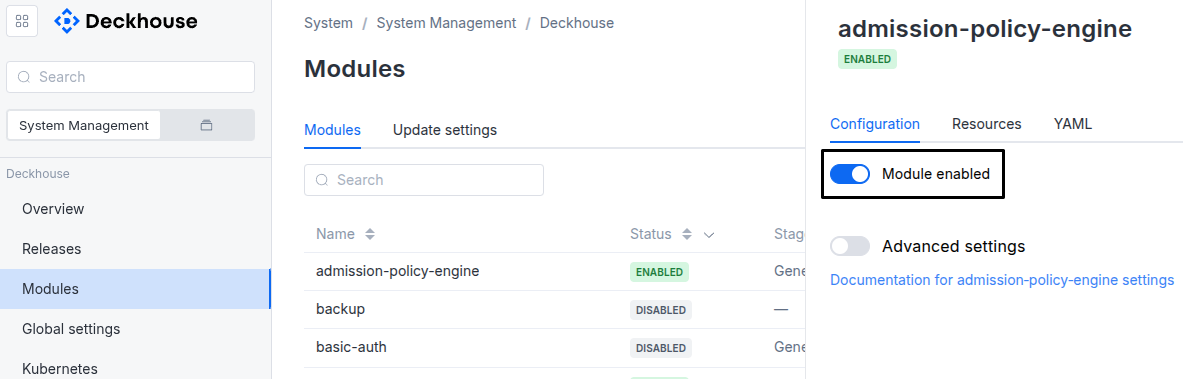
Via Deckhouse web UI. In the “System” → “System Management” → “Deckhouse” → “Modules” section, open the
ai-modelsmodule and enable (or disable) the “Module enabled” toggle. Save changes.Example:
-
Via Deckhouse CLI (d8).
Use the d8 system module enable command for enabling, or d8 system module disable command for disabling the module (you need Deckhouse CLI (d8), configured to work with the cluster).
Example of enabling the module:
d8 system module enable ai-models -
Using ModuleConfig
ai-models.Set
spec.enabledtotrueorfalsein ModuleConfigai-models(create it if necessary).Example of a manifest to enable module
ai-models:apiVersion: deckhouse.io/v1alpha1 kind: ModuleConfig metadata: name: ai-models spec: enabled: true
You can configure the module in one of the following ways:
-
Via Deckhouse web UI.
In the “System” → “System Management” → “Deckhouse” → “Modules” section, open the
ai-modelsmodule and enable the “Advanced Settings” toggle. Fill in the required fields in the “Configuration” tab or specify the module settings in YAML format on the “YAML” tab, without the top-levelsettingskey. Save the changes.Example:
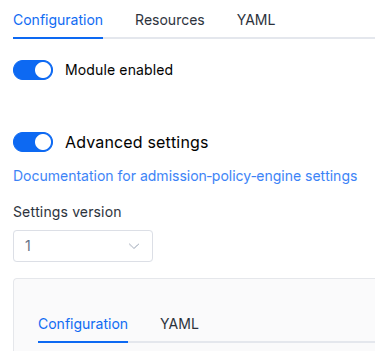
You can also edit the ModuleConfig object
ai-modelson the “YAML” tab in the module settings window (“System” → “System Management” → “Deckhouse” → “Modules”, open the moduleai-models) by specifying the schema version in thespec.versionparameter and the necessary module parameters in thespec.settingssection. -
Via Deckhouse CLI (d8) (requires Deckhouse CLI (d8) configured to work with the cluster).
Edit the existing ModuleConfig
ai-models(for more details on configuring Deckhouse Platform, see the documentation) by executing the following command:d8 k edit mc ai-modelsMake the necessary changes in the
spec.settingssection. If necessary, specify the schema version in thespec.versionparameter. Save the changes.You can also create a manifest file for ModuleConfig
ai-modelsusing the example below. Fill in thespec.settingssection with the required module parameters. If necessary, specify the schema version in thespec.versionparameter.Apply the manifest using the following command (indicate the manifest file name):
d8 k apply -f <FILENAME>Example of a manifest for ModuleConfig
ai-models:apiVersion: deckhouse.io/v1alpha1 kind: ModuleConfig metadata: name: ai-models spec: version: 1 enabled: true settings: # Module parameters from the "Parameters" section below.
Requirements
To the Kubernetes version: 1.34 and above.
To the Deckhouse Platform version: 1.75.0 and above.
Parameters
Schema version: 1
-
-
objectsettings.artifactsS3-compatible storage for upload staging, the publication store, and module byte-path data. Internal object prefixes are module-owned.
-
stringsettings.artifacts.bucket
Required value
Bucket name for upload staging and published model artifacts.Default:
‘’ -
stringsettings.artifacts.caSecretNameOptional existing Secret in
d8-systemwith keyca.crtused to trust a custom CA for the S3-compatible endpoint. When empty, the module usescredentialsSecretNameas the CA source if that Secret containsca.crt.Default:
‘’ -
stringsettings.artifacts.capacityLimitOptional total capacity budget for module-owned artifacts, for example
500Gi. When set, upload sessions must declare payload size and the upload gateway reserves capacity before staging. Empty value disables admission enforcement and reports capacity as unknown.Default:
‘’ -
stringsettings.artifacts.credentialsSecretName
Required value
Existing Secret ind8-systemwithaccessKeyandsecretKey. The Secret may also containca.crtwhen the same Secret is used as the custom S3 trust source. The module synchronizes the required data into its service namespace after the Helm-owned namespace exists. This Secret is required; inline credentials are not supported.Default:
‘’ -
stringsettings.artifacts.endpoint
Required value
S3-compatible endpoint URL.Default:
‘’ -
booleansettings.artifacts.insecureDisable TLS verification for S3-compatible endpoint access.
Default:
false -
stringsettings.artifacts.regionS3 region value used by the client.
Default:
us-east-1 -
booleansettings.artifacts.usePathStyleUse path-style S3 requests.
Default:
true
-
-
objectsettings.deliveryWorkload delivery backend. Exactly one backend is active:
SharedPVCfor controller-owned RWX PVC materialization, orNodeCachefor SDS-backed node-local cache and CSI delivery. Perimeter distribution is separate from workload delivery and is not an additionaldelivery.typevalue.-
integersettings.delivery.maxConcurrentMaterializationsMaximum number of
SharedPVCmaterializer Jobs running concurrently cluster-wide. Each consumer namespace materializes the model into its own ReadWriteMany PVC; these materializations contend for registry read and storage write bandwidth, so throughput saturates at low concurrency and degrades beyond it. A conservative bound keeps per-materialization latency low so pods do not sit inSchedulingGatedfor minutes; raise it on clusters with more nodes or faster storage. Empty value means2.Allowed values:
1 <= X <= 64Examples:
maxConcurrentMaterializations: 2maxConcurrentMaterializations: 4 -
objectsettings.delivery.nodeCacheBlockDeviceSelectorMatchLabels selector for BlockDevice resources used to build the managed cache volume group. Empty value means
ai.deckhouse.io/model-cache=true.Example:
ai.deckhouse.io/model-cache: 'true' -
objectsettings.delivery.nodeCacheNodeSelectorMatchLabels selector for nodes that should host managed node-local cache substrate. Empty value means
ai.deckhouse.io/model-cache=true.Example:
ai.deckhouse.io/model-cache: 'true' -
stringsettings.delivery.nodeCacheSizePer-node cache size for
NodeCache. The same value is used for managed local storage capacity and for the per-node shared cache PVC. Empty value means200Gi.Example:
nodeCacheSize: 200Gi -
stringStorageClass name for
SharedPVCdelivery. Empty value means Deckhouse global storage class settings first, then Kubernetes defaultStorageClass. The resolved class must exist, be unambiguous and usevolumeBindingMode: Immediatebefore workload delivery can create the shared ReadWriteMany PVC. AWaitForFirstConsumerclass cannot be used: delivery waits for the volume to bind before creating its consumer, so such a volume would never bind.Examples:
sharedPVCStorageClassName: rwx-storage-classsharedPVCStorageClassName: nfs-rwx -
stringsettings.delivery.type
Required value
Workload delivery backend.
SharedPVCis the default. It creates controller-owned RWX PVCs in workload namespaces. Emptydelivery.sharedPVCStorageClassNameresolves through Deckhouse global storage class settings (global.modules.storageClass, thenglobal.defaultClusterStorageClass) and then Kubernetes defaultStorageClass. The resolved class must exist, be unambiguous and usevolumeBindingMode: Immediate. Unmet prerequisites are reported at the module level as soon as the module starts, through thed8_ai_models_storage_prerequisites_satisfiedmetric and theD8AIModelsStoragePrerequisitesNotSatisfiedalert, without waiting for a workload; the module stays enabled and its catalog surfaces keep working while degraded. Per workload the same defects appear as gate reasonsSharedPVCStorageClassMissingandSharedPVCStorageClassAmbiguous. The storage provisioner is responsible for provisioning the resulting ReadWriteMany PVC; a failure it reports is surfaced with reasonSharedPVCProvisioningFailed, and a volume left unprovisioned with no reported cause becomesSharedPVCProvisioningTimedOutinstead of waiting indefinitely.NodeCachecreates managed SDS-backed node-local cache substrate and read-only CSI mounts.Default:
SharedPVCAllowed values:
SharedPVC,NodeCache
-
-
objectsettings.distributionDistribution mode for published model artifacts. This setting is independent from workload delivery:
delivery.typecontrols how workloads mount artifacts, whiledistribution.modecontrols whether the module exposes the publication byte path as a controller-owned distribution surface for downstream catalog/import topologies.-
stringsettings.distribution.mode
Required value
Distribution mode.
InternalOnlykeeps the publication registry available only inside the cluster.PublicCatalogexposes a public/v2transport endpoint on the module public host. Semantic catalog API andModelCatalogSourceimport are implemented in the controller/API slice; users do not configure model lists, registry paths, or custom hosts here.Default:
InternalOnlyAllowed values:
InternalOnly,PublicCatalog
-
-
objectsettings.externalCatalogExternal provider catalog browse/search/import configuration. This enables the future provider-index path for sources such as Hugging Face. Remote provider entries are stored outside Kubernetes etcd and become local
ModelorClusterModelobjects only after explicit import. PostgreSQL and Valkey services must already exist; the module only reads connection Secrets and does not provision database or cache instances.-
objectsettings.externalCatalog.dataServicesConnection Secret names for already provisioned external catalog data services. PostgreSQL stores durable provider index data. Valkey stores short-lived cache, rate-limit counters and locks. The module validates Secret presence, connection string shape and bounded live probes before reporting external catalog readiness. PostgreSQL is checked with a temporary read/write probe. Valkey is checked with PING, TTL read/write, lock and rate-limit key probes.
-
stringsettings.externalCatalog.dataServices.postgresConnectionSecretNameExisting Secret name in
d8-systemwith keydsn. The value must be a PostgreSQL DSN usingpostgres://orpostgresql://and include a database name. The Secret may also containca.crtfor a private CA.Default:
‘’ -
stringsettings.externalCatalog.dataServices.valkeyConnectionSecretNameExisting Secret name in
d8-systemwith keyurl. The value must be a Valkey-compatible URL usingredis://orrediss://. The Secret may also containca.crtfor a private CA.Default:
‘’
-
-
booleansettings.externalCatalog.enabledEnable external provider catalog data-service readiness checks. When
true,dataServices.postgresConnectionSecretNameanddataServices.valkeyConnectionSecretNameare required and must name existing Secrets ind8-system.Default:
false
-
-
stringsettings.logLevelLogging level for module runtime components.
Default:
InfoAllowed values:
Debug,Info,Warn,Error
-