Available in editions: Open/CE, BE, SE, SE+, Ultimate/EE, Core
Included in extensions: Cluster Union
The module lifecycle stage: General Availability
The module does not have any mandatory parameters.
The module has 6 alerts.
The module is enabled by default in the following bundles: Default, Managed.
The module is disabled by default in the Minimal bundle.
How to explicitly enable the module...
You may explicitly enable or disable the module in one of the following ways:
-
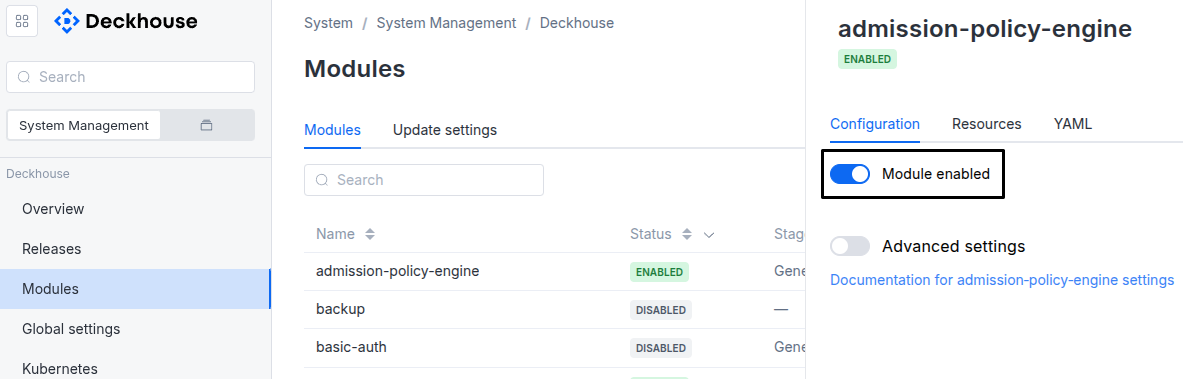
Via Deckhouse web UI. In the “System” → “System Management” → “Deckhouse” → “Modules” section, open the
cert-managermodule and enable (or disable) the “Module enabled” toggle. Save changes.Example:
-
Via Deckhouse CLI (d8).
Use the d8 system module enable command for enabling, or d8 system module disable command for disabling the module (you need Deckhouse CLI (d8), configured to work with the cluster).
Example of enabling the module:
d8 system module enable cert-manager -
Using ModuleConfig
cert-manager.Set
spec.enabledtotrueorfalsein ModuleConfigcert-manager(create it if necessary);Example of a manifest to enable module
cert-manager:apiVersion: deckhouse.io/v1alpha1 kind: ModuleConfig metadata: name: cert-manager spec: enabled: true
How to configure the module...
You can configure the module in one of the following ways:
-
Via Deckhouse web UI.
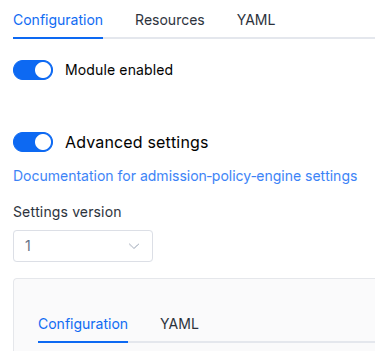
In the “System” → “System Management” → “Deckhouse” → “Modules” section, open the
cert-managermodule and enable the “Advanced Settings” switch. Fill in the required fields in the “Configuration” tab or specify the module settings in YAML format on the “YAML” tab, excluding the settings section. Save the changes.Example:
You can also edit the ModuleConfig object
cert-manageron the “YAML” tab in the module settings window (“System” → “System Management” → “Deckhouse” → “Modules”, open the modulecert-manager) by specifying the schema version in thespec.versionparameter and the necessary module parameters in thespec.settingssection. -
Via Deckhouse CLI (d8) (requires Deckhouse CLI (d8) configured to work with the cluster).
Edit the existing ModuleConfig
cert-manager(for more details on configuring Deckhouse, see the documentation) by executing the following command:d8 k edit mc cert-managerMake the necessary changes in the
spec.settingssection. If necessary, specify the schema version in thespec.versionparameter. Save the changes.You can also create a file with manifest for ModuleConfig
cert-managerusing the example below. Fill in thespec.settingssection with the required module parameters. If necessary, specify the schema version in thespec.versionparameter.Apply the manifest using the following command (indicate the manifest file name):
d8 k apply -f <FILENAME>Example of a manifest for ModuleConfig
cert-manager:apiVersion: deckhouse.io/v1alpha1 kind: ModuleConfig metadata: name: cert-manager spec: version: 1 enabled: true settings: # Module parameters from the "Parameters" section below.
Parameters
Schema version: 1
- objectsettings
- booleansettings.cleanupOrphanSecrets
Delete a secret with a certificate automatically if the corresponding Certificate resource was deleted from the cluster.
Default:
falseExamples:
cleanupOrphanSecrets: truecleanupOrphanSecrets: false - stringsettings.cloudDNSServiceAccount
The Service Account for Google Cloud for the same project that has the DNS Administrator role.
Example:
cloudDNSServiceAccount: eyJzYSI6ICJhYmNkZWZnaEBzZXJ2aWNlYWNjb3VudC5jb20iLCAicHJvamVjdF9pZCI6ImFhYWFhIn0= - stringsettings.cloudflareAPIToken
API Tokens allow application-scoped keys bound to specific DNS zones.
API Tokens are recommended for higher security, since they have more restrictive permissions and are more easily revocable.
It allows you to verify that domains specified in the Certificate resource are managed by
cert-managerand kept by the Cloudflare DNS provider. Verification is performed by adding special TXT records for the ACME DNS01 Challenge Provider domain.Example:
cloudflareAPIToken: token - stringsettings.cloudflareEmail
The email used for accessing the Cloudflare platform.
Example:
cloudflareEmail: example@example.com - stringsettings.cloudflareGlobalAPIKey
The Cloudflare Global API key for managing DNS records
It allows you to verify that domains specified in the Certificate resource are managed by
cert-managerand kept by the Cloudflare DNS provider.Verification is performed by adding special TXT records for the ACME DNS01 Challenge Provider domain.
Example:
cloudflareGlobalAPIKey: key - stringsettings.digitalOceanCredentials
The Access Token for the Digital Ocean API (you can create it in the
APIsection).Example:
digitalOceanCredentials: creds - booleansettings.disableLetsencrypt
Disable
letsencryptandletsencrypt-stagingClusterIssuer objects (if set totrue).Examples:
disableLetsencrypt: truedisableLetsencrypt: false - stringsettings.email
The email used for sending notifications by LetsEncrypt.
Example:
email: example@example.com - booleansettings.enableCAInjector
Enable CAInjector. It only needs to inject CA certs into
ValidatingWebhookConfiguration,MutatingWebhookConfiguration,CustomResourceDefinitionandAPIService. Deckhouse does not use CAInjector, so you have to enable it only if you use custom CA injections in your services.Default:
falseExamples:
enableCAInjector: trueenableCAInjector: false - booleansettings.enableListenerSet
Enable ListenerSet support in cert-manager by turning on the
ListenerSetsfeature gate.Additionally, when Gateway API integration is enabled, this flag also enables ListenerSet integration for Gateway API.
Default:
falseExamples:
enableListenerSet: trueenableListenerSet: false - stringsettings.ingressClassHttp01
The name of the
ingressClassused to confirm ownership of domain using the ACME HTTP-01 challenges method. If the parameter is omitted, the defaultingressClassis used.Example:
ingressClassHttp01: nginx - objectsettings.letsencrypt
Settings for the
letsencryptClusterIssuer.- objectsettings.letsencrypt.resources
Resource requests and limits (CPU and memory) for the workload using the
letsencryptClusterIssuer.Example:
resources: requests: cpu: 100m memory: 128Mi limits: cpu: 250m memory: 256Mi- objectsettings.letsencrypt.resources.limits
- stringsettings.letsencrypt.resources.limits.cpu
Required value
The same as in the pods’
spec.containers.resources.limits.cpuparameter in Kubernetes.Default:
50mPattern:
^[0-9]+m?$ - string or numbersettings.letsencrypt.resources.limits.memory
Required value
The same as in the pods’
spec.containers.resources.limits.memoryparameter in Kubernetes.Default:
64MiPattern:
^[0-9]+(\.[0-9]+)?(E|P|T|G|M|k|Ei|Pi|Ti|Gi|Mi|Ki)?$
- objectsettings.letsencrypt.resources.requests
Resource requests and limits (CPU and memory) for pods that create the
letsencryptClusterIssuer for http01 challenges- stringsettings.letsencrypt.resources.requests.cpu
Required value
The same as in the pods’
spec.containers.resources.requests.cpuparameter in Kubernetes.Default:
10mPattern:
^[0-9]+m?$ - string or numbersettings.letsencrypt.resources.requests.memory
Required value
The same as in the pods’
spec.containers.resources.requests.memoryparameter in Kubernetes.Default:
32MiPattern:
^[0-9]+(\.[0-9]+)?(E|P|T|G|M|k|Ei|Pi|Ti|Gi|Mi|Ki)?$
- objectsettings.letsencryptStaging
Settings for the
letsencrypt-stagingClusterIssuer.- objectsettings.letsencryptStaging.resources
Resource requests and limits (CPU and memory) for pods that create the
letsencrypt-stagingClusterIssuer for http01 challenges.Example:
resources: requests: cpu: 100m memory: 128Mi limits: cpu: 250m memory: 256Mi- objectsettings.letsencryptStaging.resources.limits
- stringsettings.letsencryptStaging.resources.limits.cpu
Required value
The same as in the pods’
spec.containers.resources.limits.cpuparameter in Kubernetes.Default:
50mPattern:
^[0-9]+m?$ - string or numbersettings.letsencryptStaging.resources.limits.memory
Required value
The same as in the pods’
spec.containers.resources.limits.memoryparameter in Kubernetes.Default:
64MiPattern:
^[0-9]+(\.[0-9]+)?(E|P|T|G|M|k|Ei|Pi|Ti|Gi|Mi|Ki)?$
- objectsettings.letsencryptStaging.resources.requests
- stringsettings.letsencryptStaging.resources.requests.cpu
Required value
The same as in the pods’
spec.containers.resources.requests.cpuparameter in Kubernetes.Default:
10mPattern:
^[0-9]+m?$ - string or numbersettings.letsencryptStaging.resources.requests.memory
Required value
The same as in the pods’
spec.containers.resources.requests.memoryparameter in Kubernetes.Default:
32MiPattern:
^[0-9]+(\.[0-9]+)?(E|P|T|G|M|k|Ei|Pi|Ti|Gi|Mi|Ki)?$
- integersettings.maxConcurrentChallenges
The maximum number of challenges that can be scheduled as ‘processing’ at once. (default 60)
Allowed values:
0 <= XExample:
maxConcurrentChallenges: 25 - objectsettings.nodeSelector
The same as in the pods’
spec.nodeSelectorparameter in Kubernetes.If the parameter is omitted or
false, it will be determined automatically.Example:
nodeSelector: has-gpu: 'true' - objectsettings.recursiveSettings
Parameters for using recursive DNS servers, which are used to check the existence of a DNS record, before initiating the domain ownership verification process using the ACME DNS-01 method.
Example:
recursiveSettings: nameservers: - 8.8.8.8:53 - https://1.1.1.1 useOnlyRecursive: true- array of stringssettings.recursiveSettings.nameservers
List of recursive DNS servers (IP:port or HTTPS URLs).
- stringElement of the array
Pattern:
^(?:[0-9]{1,3}(?:\.[0-9]{1,3}){3}:\d{1,5}|https?://[^\s]+)$
- booleansettings.recursiveSettings.useOnlyRecursive
When set to true, only the specified recursive DNS servers will be used to check for the existence of a record in the DNS before starting the domain ownership verification process.
Default:
false
- stringsettings.route53AccessKeyID
The Access Key ID of the user with the attached Amazon Route53 IAM Policy for managing domain records.
Example:
route53AccessKeyID: key_id - stringsettings.route53SecretAccessKey
The Secret Access Key of the user with privileges to manage domain records.
Example:
route53SecretAccessKey: secret - array of objectssettings.tolerations
The same as in the pods’
spec.tolerationsparameter in Kubernetes.If the parameter is omitted or
false, it will be determined automatically.Example:
tolerations: - key: dedicated.deckhouse.io operator: Equal value: cert-manager- stringsettings.tolerations.effect
- stringsettings.tolerations.key
- stringsettings.tolerations.operator
- integersettings.tolerations.tolerationSeconds
- stringsettings.tolerations.value