Available in editions: Open/CE, BE, SE, SE+, Ultimate/EE, Core
The module lifecycle stage: General Availability
Some cluster parameters that affect control plane management historically came from the ClusterConfiguration resource. Prefer the corresponding settings in this ModuleConfig instead — for example, kubernetesVersion. The ClusterConfiguration fields remain only as a deprecated fallback during migration.
The module has 35 alerts.
The module is enabled by default in the Default bundle.
The module is disabled by default in the following bundles: Managed, Minimal.
How to explicitly enable the module...
You may explicitly enable or disable the module in one of the following ways:
-
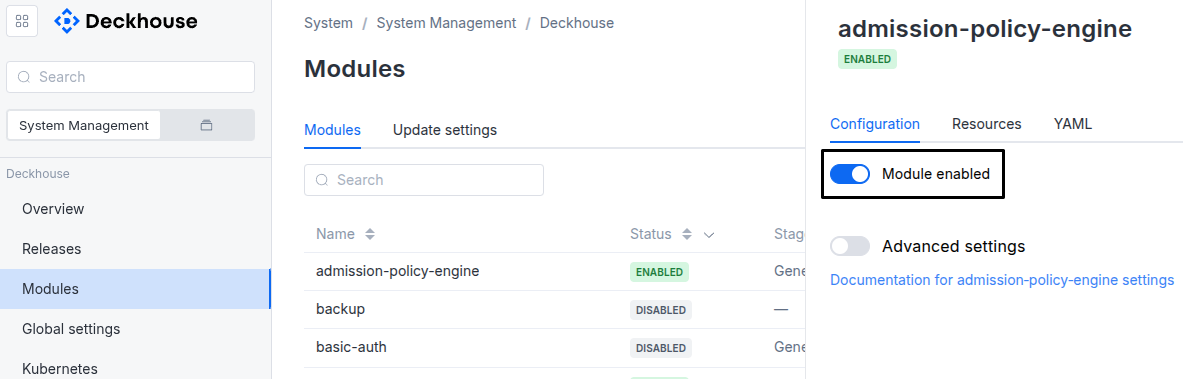
Via Deckhouse web UI. In the “System” → “System Management” → “Deckhouse” → “Modules” section, open the
control-plane-managermodule and enable (or disable) the “Module enabled” toggle. Save changes.Example:
-
Via Deckhouse CLI (d8).
Use the d8 system module enable command for enabling, or d8 system module disable command for disabling the module (you need Deckhouse CLI (d8), configured to work with the cluster).
Example of enabling the module:
d8 system module enable control-plane-manager -
Using ModuleConfig
control-plane-manager.Set
spec.enabledtotrueorfalsein ModuleConfigcontrol-plane-manager(create it if necessary);Example of a manifest to enable module
control-plane-manager:apiVersion: deckhouse.io/v1alpha1 kind: ModuleConfig metadata: name: control-plane-manager spec: enabled: true
How to configure the module...
You can configure the module in one of the following ways:
-
Via Deckhouse web UI.
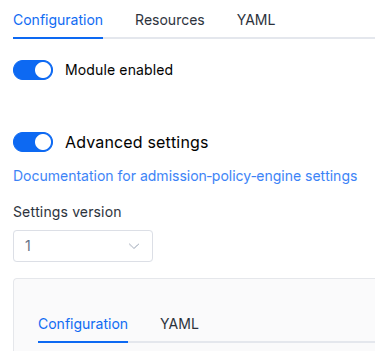
In the “System” → “System Management” → “Deckhouse” → “Modules” section, open the
control-plane-managermodule and enable the “Advanced Settings” switch. Fill in the required fields in the “Configuration” tab or specify the module settings in YAML format on the “YAML” tab, excluding the settings section. Save the changes.Example:
You can also edit the ModuleConfig object
control-plane-manageron the “YAML” tab in the module settings window (“System” → “System Management” → “Deckhouse” → “Modules”, open the modulecontrol-plane-manager) by specifying the schema version in thespec.versionparameter and the necessary module parameters in thespec.settingssection. -
Via Deckhouse CLI (d8) (requires Deckhouse CLI (d8) configured to work with the cluster).
Edit the existing ModuleConfig
control-plane-manager(for more details on configuring Deckhouse, see the documentation) by executing the following command:d8 k edit mc control-plane-managerMake the necessary changes in the
spec.settingssection. If necessary, specify the schema version in thespec.versionparameter. Save the changes.You can also create a file with manifest for ModuleConfig
control-plane-managerusing the example below. Fill in thespec.settingssection with the required module parameters. If necessary, specify the schema version in thespec.versionparameter.Apply the manifest using the following command (indicate the manifest file name):
d8 k apply -f <FILENAME>Example of a manifest for ModuleConfig
control-plane-manager:apiVersion: deckhouse.io/v1alpha1 kind: ModuleConfig metadata: name: control-plane-manager spec: version: 3 enabled: true settings: # Module parameters from the "Parameters" section below.
Conversions
The module is configured using the ModuleConfig resource, the schema of which contains a version number. When you apply an old version of the ModuleConfig schema in a cluster, automatic transformations are performed. To manually update the ModuleConfig schema version, the following steps must be completed sequentially for each version :
- Updates from version 1 to 2:
Delete
etcd.externalMembersNames - Updates from version 2 to 3:
Replace
.apiserver.loadBalancerwith.apiserver.publishAPI.loadBalancer.
Parameters
Schema version: 3
Example:
apiVersion: deckhouse.io/v1alpha1
kind: ModuleConfig
metadata:
  name: control-plane-manager
spec:
  version: 3
  enabled: true
  settings:
    resourcesRequests:
      cpu: 1000m
      memory: 500Mi
    apiserver:
      bindToWildcard: true
      certSANs:
      - bakery.infra
      - devs.infra
      publishAPI: {}
- objectsettings
- objectsettings.apiserver
kube-apiserverparameters.- array of stringssettings.apiserver.admissionPlugins
List of enabled additional admission plugins.
Note, that in addition to the admission plugins enabled by default in Kubernetes, the following admission plugins are also always enabled:
ExtendedResourceTolerationPodNodeSelectorPodTolerationRestrictionNodeRestriction-
EventRateLimitwith the following config:apiVersion: eventratelimit.admission.k8s.io/v1alpha1 kind: Configuration limits: - type: Namespace qps: 50 burst: 100 cacheSize: 2000
Note that the
PodNodeSelectoradmission plugin does not require specifying a global configuration, it relies on annotated Namespaces.During DP installation, Kubernetes enables the standard admission plugins. In addition to these, the module enables several more. For details, see the “Admission plugins enabled by default” section.
The
PodNodeSelectorandPodTolerationRestrictionvalues are kept in the list of allowed values for backward compatibility only: these plugins are always enabled, so specifying them has no effect and causes no error.Example:
admissionPlugins: - AlwaysPullImages - NamespaceAutoProvision- stringElement of the array
Allowed values:
AlwaysPullImages,NamespaceAutoProvision,OwnerReferencesPermissionEnforcement,PodNodeSelector,PodTolerationRestriction
- objectsettings.apiserver.auditLog
Audit policy settings
Default:
{"output":"File"}- stringsettings.apiserver.auditLog.output
Required value
Audit logs target stream.
Default:
FileAllowed values:
File,StdoutExample:
output: Stdout - stringsettings.apiserver.auditLog.path
Directory path for logs if the output is “File”, otherwise ignored.
Default:
/var/log/kube-auditPattern:
^[a-zA-Z0-9_/.-]+[a-zA-Z0-9_.-]$
- booleansettings.apiserver.auditPolicyEnabled
Set the audit policies using the configuration from the
kube-system/audit-policySecret.Default:
false - objectsettings.apiserver.authn
Optional authentication parameters for Kubernetes API clients.
By default, they are taken from user-authn module ConfigMap.
- stringsettings.apiserver.authn.oidcCA
OIDC provider CA.
- stringsettings.apiserver.authn.oidcIssuerAddress
OIDC provider network address alias.
Examples:
oidcIssuerAddress: 1.2.3.4oidcIssuerAddress: '' - stringsettings.apiserver.authn.oidcIssuerURL
OIDC provider URL.
Example:
oidcIssuerURL: https://my-super-site.tech/ - stringsettings.apiserver.authn.webhookCA
Authorization webhook CA.
- stringsettings.apiserver.authn.webhookCacheTTL
The duration to cache responses from the webhook token authenticator.
It is specified as a string containing the time unit in hours and minutes: 30m, 1h, 2h30m, 24h.
Pattern:
^([0-9]+h)?([0-9]+m)?([0-9]+s)?$Example:
webhookCacheTTL: 5m - stringsettings.apiserver.authn.webhookURL
Authentication webhook URL.
Example:
webhookURL: https://127.0.0.1:40443/
- objectsettings.apiserver.authz
Optional authorization parameters for Kubernetes API clients.
By default, they are taken from user-authz module ConfigMap.
- stringsettings.apiserver.authz.webhookCA
Authorization webhook CA.
- stringsettings.apiserver.authz.webhookURL
Authorization webhook URL.
Example:
webhookURL: https://127.0.0.1:40443/
- booleansettings.apiserver.basicAuditPolicyEnabled
Enforce basic Deckhouse audit policies.
Default:
true - booleansettings.apiserver.bindToWildcard
Specifies whether to listen on
0.0.0.0.By default, the API server listens on the hostIP. The latter usually corresponds to the Internal node address; however, the actual IP depends on the cluster type (Static or Cloud) and the layout selected.
Default:
false - array of stringssettings.apiserver.certSANs
Array of SANs, with which the API server certificate will be generated.
In addition to the passed list, the following list is always used:
kubernetes;kubernetes.default;kubernetes.default.svc;kubernetes.default.svc.cluster.local;- Kubernetes API server address;
127.0.0.1;- host name;
- host IP.
Example:
certSANs: - my-site.com - 192.168.67.76- stringElement of the array
Pattern:
^[0-9a-zA-Z\.-]+$
- booleansettings.apiserver.encryptionEnabled
Enables data encryption in etcd (see Encrypting secret data at rest).
When enabled, a Secret
kube-system/d8-secret-encryption-keyis created to store the encryption key.Sensitive custom resource fields marked with
x-kubernetes-sensitive-data: trueare protected by theCRDSensitiveDatafeature gate forkube-apiserver, which is enabled by default. Enabling this parameter adds encryption in etcd to RBAC-based field filtering with the<resource>/sensitivesubresource and hiding values from the audit log.Warning. Once enabled, this parameter can’t be disabled.
Default:
false - objectsettings.apiserver.publishAPI
Publishing access to Kubernetes API.
- objectsettings.apiserver.publishAPI.ingress
Settings for PublishAPI type Ingress.
- booleansettings.apiserver.publishAPI.ingress.addKubeconfigGeneratorEntry
Setting it to
falsewill remove an entry in kubeconfig-generator.Default:
true - booleansettings.apiserver.publishAPI.ingress.enabled
Setting it to
truewill create an Ingress resourcekubernetes-apiin thekube-systemnamespace in the cluster (it exposes the Kubernetes API).Default:
false - objectsettings.apiserver.publishAPI.ingress.https
The HTTPS mode for the API server Ingress.
Examples:
https: mode: SelfSignedhttps: mode: Global global: kubeconfigGeneratorMasterCA: plainstring- objectsettings.apiserver.publishAPI.ingress.https.global
An additional parameter for the
Globalmode.- stringsettings.apiserver.publishAPI.ingress.https.global.kubeconfigGeneratorMasterCA
If there is an external load balancer in front of the Ingress that terminates HTTPS traffic using non-public CA, then you need to specify the CA so it will be included in kubectl-config.
If you are using certificates issued by the
cert-managermodule and Let’s Encrypt in your cluster, you should set an empty string""as the value.Also, you can set the external LB’s certificate itself as a CA if you can’t get the CA that signed it for some reason. Note that after the certificate is updated on the LB, all the previously generated kubeconfigs will stop working.
- stringsettings.apiserver.publishAPI.ingress.https.mode
The mode of issuing certificates for the Ingress resource.
In the
SelfSignedmode, a CA-signed certificate will be issued for the Ingress resource.Use the following command to get the certificate:
d8 k -n kube-system get secrets kubernetes-api-ca-key-pair -oyaml.In the
Globalmode, the policies specified in theglobal.modules.https.modeglobal parameter will be applied. Thus, if the global parameter has theCertManagermode set (withletsencryptas the ClusterIssuer), then the Let’s Encrypt certificate will be issued for the Ingress resource.Default:
SelfSignedAllowed values:
SelfSigned,Global
- stringsettings.apiserver.publishAPI.ingress.ingressClass
The Ingress class that will be used to expose the Kubernetes API via Ingress.
Pattern:
^[a-z0-9]([-a-z0-9]*[a-z0-9])?(\.[a-z0-9]([-a-z0-9]*[a-z0-9])?)*$ - array of stringssettings.apiserver.publishAPI.ingress.whitelistSourceRanges
An array of CIDRs that are allowed to connect to the API server.
- stringElement of the array
Pattern:
^(([0-9]|[1-9][0-9]|1[0-9]{2}|2[0-4][0-9]|25[0-5])\.){3}([0-9]|[1-9][0-9]|1[0-9]{2}|2[0-4][0-9]|25[0-5])(\/(3[0-2]|[1-2][0-9]|[0-9]))?$
- objectsettings.apiserver.publishAPI.loadBalancer
Settings type LoadBalancer
- objectsettings.apiserver.publishAPI.loadBalancer.annotations
Annotations to attach to a service to fine-tune the load balancer.
Caution! The module does not take into account the specifics of setting annotations in various cloud environments. If the annotations for load balancer provisioning are only applied when creating a service, you will need to delete and add the
apiserver.loadBalancerparameter to update such parameters. - booleansettings.apiserver.publishAPI.loadBalancer.enabled
If set to
true, servicekube-system/d8-control-plane-apiserverof the LoadBalancer type will be created.Default:
false - integersettings.apiserver.publishAPI.loadBalancer.port
External LoadBalancer TCP port.
Default:
443Allowed values:
1 <= X <= 65534 - array of stringssettings.apiserver.publishAPI.loadBalancer.sourceRanges
A list of CIDRs that are allowed to connect to the API.
The cloud provider may not support this option or ignore it.
- stringElement of the array
Pattern:
^[0-9]{1,}\.[0-9]{1,}\.[0-9]{1,}\.[0-9]{1,}\/[0-9]+$
- objectsettings.apiserver.serviceAccount
ServiceAccount issuing settings.
Examples:
serviceAccount: {}serviceAccount: additionalAPIAudiences: - istio-ca- array of stringssettings.apiserver.serviceAccount.additionalAPIAudiences
A list of API audiences to add when provisioning ServiceAccount tokens.
The default audiences list includes:
serviceAccount.issuer, if specified.serviceAccount.additionalAPIIssuers, if specified.https://kubernetes.default.svc.${clusterDomain}, for example,https://kubernetes.default.svc.cluster.local– this audience is always added for backward compatibility.
The service account token authenticator will validate that tokens used against the API are bound to at least one of these audiences.
This option is beneficial when migrating from one API issuer to another.
- array of stringssettings.apiserver.serviceAccount.additionalAPIIssuers
A list of additional issuers to include when provisioning ServiceAccount tokens.
Issuers (
iss) are used to verify the source of the tokens, ensuring they originate from trusted entities.The first issuer is automatically generated based on the template
https://kubernetes.default.svc.${clusterDomain}, for example,https://kubernetes.default.svc.cluster.local. When multiple issuers are specified, the first issuer is used to generate tokens, and all provided issuers are accepted for token verification.This option is beneficial when migrating from one API issuer to another.
- stringsettings.apiserver.serviceAccount.issuer
ServiceAccount issuer. This is the URL of the API server. The values of this field are used as the
issclaim of the token and to verify Service Account JWT tokens.Note, all pods in the cluster using ServiceAccount tokens must be restarted upon changing this option.
Example:
issuer: https://api.example.com
- array of stringssettings.enabledFeatureGates
List of feature gates enabled in the control plane.
More information about feature gates is available in the Kubernetes documentation. The list of feature gates supported in DP can be found on the module overview page.
Default:
[]- stringElement of the array
Pattern:
^[a-zA-Z][a-zA-Z0-9]*$
- stringsettings.encryptionAlgorithm
Asymmetric encryption algorithm used when generating keys and certificates for the following control-plane components:
apiserver;apiserver-kubelet-client;apiserver-etcd-client;front-proxy-client;etcd-server;etcd-peer;etcd-healthcheck-client.
Certificates for the components listed above will be reissued using the selected algorithm and key length.
If parameter not set, the value from
ClusterConfiguration.encryptionAlgorithmis used (defaults toRSA-2048).Warning. When reissuing certificates, the root certificate (CA) is not rotated. The root certificate is created with the selected algorithm only during the initial cluster bootstrap.
Default:
RSA-2048Allowed values:
RSA-2048,RSA-3072,RSA-4096,ECDSA-P256Example:
encryptionAlgorithm: ECDSA-P256 - objectsettings.etcd
etcdparameters.- objectsettings.etcd.backup
etcd backup parameters.
- stringsettings.etcd.backup.cronSchedule
Backup schedule etcd in cron format. The local time zone of the
kube-controller-manageris used.Backups on different master nodes are started with a 15-minute offset from each other to avoid simultaneous disk load on all etcd members. Nodes are processed in reverse order of their names, so the node with the lowest name (for example,
master-0) is backed up last and stores the most recent snapshot.Default:
0 0 * * *Example:
cronSchedule: 0 1 * * * - booleansettings.etcd.backup.enabled
Enable etcd backup.
Default:
true - stringsettings.etcd.backup.hostPath
Host path on masters nodes for etcd backup.
Default:
/var/lib/etcd
- objectsettings.etcd.defrag
etcd defragmentation parameters.
Default:
{"cronSchedule":"0 1 * * *"}- stringsettings.etcd.defrag.cronSchedule
Defragmentation schedule in cron format (UTC).
Default:
0 1 * * *Pattern:
^(\*(\/[0-9]+)?|[0-9]+(-[0-9]+)?(\/[0-9]+)?(,[0-9]+(-[0-9]+)?(\/[0-9]+)?)*)\s+(\*(\/[0-9]+)?|[0-9]+(-[0-9]+)?(\/[0-9]+)?(,[0-9]+(-[0-9]+)?(\/[0-9]+)?)*)\s+(\*(\/[0-9]+)?|[0-9]+(-[0-9]+)?(\/[0-9]+)?(,[0-9]+(-[0-9]+)?(\/[0-9]+)?)*)\s+(\*(\/[0-9]+)?|[0-9]+(-[0-9]+)?(\/[0-9]+)?(,[0-9]+(-[0-9]+)?(\/[0-9]+)?)*)\s+(\*(\/[0-9]+)?|[0-9]+(-[0-9]+)?(\/[0-9]+)?(,[0-9]+(-[0-9]+)?(\/[0-9]+)?)*)$Example:
cronSchedule: 0 1 * * * - booleansettings.etcd.defrag.enabled
Enable periodic etcd defragmentation.
Defaults to
truewhen the cluster has three or more etcd members (masters ≥ 3, or masters = 2 with an etcd-arbiter node); otherwise defaults tofalse. An explicit value always takes priority over the computed default.Warning. Enabling defragmentation on a single-master cluster will cause a brief control plane unavailability while etcd is being defragmented.
- numbersettings.etcd.maxDbSize
quota-backend-bytes parameter. Deckhouse automatically manages the
quota-backend-bytesparameter. If themaxDbSizeparameter is set, deckhouse will use this value for thequota-backend-bytesetcd parameter.Minimum: 512MB.
Maximum: 8GB.
Experimental. It can be removed in the future.
Allowed values:
536870912 <= X <= 8589934592
- integersettings.failedNodePodEvictionTimeoutSeconds
The number of seconds after which pods will be deleted from the node with the
Unreachablestatus.Note! If you change the parameter, the pods must be restarted.
Default:
300 - stringsettings.kubernetesVersion
Desired Kubernetes version of the control plane components.
This is the preferred place to manage the cluster Kubernetes version. Edit with:
d8 k edit mc control-plane-managerThe cluster Kubernetes version is resolved in the following order: this parameter, then the deprecated
ClusterConfiguration.kubernetesVersion, then the version the current Deckhouse release defaults to. This parameter wins whenever it is set,Defaultincluded; while it is unset, the deprecated field still decides.If
Defaultis specified, DP selects the version considered stable for the current release. If that version is more than 1 minor version below the maximum version that has ever been used in the cluster, the version is not changed automatically.Downgrading more than 1 minor version below the highest version the cluster has ever run is forbidden.
Allowed values:
1.33,1.34,1.35,1.36,1.37,DefaultExamples:
kubernetesVersion: '1.35'kubernetesVersion: Default - objectsettings.network
Cluster network parameters.
Each parameter is resolved in the following order: this section, then the deprecated same-named field in
ClusterConfiguration. A parameter set here wins; while it is unset, the deprecated field still decides.Warning.
podSubnetCIDR,serviceSubnetCIDRandpodSubnetNodeCIDRPrefixdescribe the network of a running cluster. Changing any of them after the cluster is bootstrapped is extremely dangerous and can lead to complete cluster failure, so it is blocked by admission. It is strongly recommended to recreate the cluster instead. See documentation for details.clusterDomainis not subject to this warning: changing it is a normal, documented procedure.- stringsettings.network.clusterDomain
Cluster domain (used for local routing).
Set the cluster domain here. The same field in
ClusterConfigurationis deprecated and will be removed in a future release.Please note: the domain must not match the domain used in the DNS name template in the publicDomainTemplate parameter. For example, you cannot set
clusterDomain: cluster.localandpublicDomainTemplate: %s.cluster.localat the same time.When moving the value from
ClusterConfiguration, keep it exactly as it is now: a different value is rejected. To change the domain later, follow the documented procedure.Default:
cluster.localPattern:
^[0-9a-zA-Z._-]+$Example:
clusterDomain: cluster.local - stringsettings.network.podSubnetCIDR
Address space of the cluster’s Pods.
When migrating from the deprecated
ClusterConfiguration.podSubnetCIDR, the value must match the one the cluster currently runs with; admission rejects a mismatch.Pattern:
^[0-9]{1,3}\.[0-9]{1,3}\.[0-9]{1,3}\.[0-9]{1,3}/[0-9]{1,2}$Example:
podSubnetCIDR: 10.111.0.0/16 - stringsettings.network.podSubnetNodeCIDRPrefix
The prefix size of the Pod network allocated to each node.
This parameter determines how many IP addresses are available for Pods on each individual node. For example, if
podSubnetCIDR: 10.111.0.0/16andpodSubnetNodeCIDRPrefix: "24", each node will receive a/24subnet (e.g.,10.111.0.0/24,10.111.1.0/24, etc.), providing up to 254 IP addresses per node (253 usable for Pods, accounting for network and broadcast addresses).Calculation examples:
- With
/16network and/24prefix: maximum 256 nodes (2^(24-16) = 256) - With
/16network and/25prefix: maximum 512 nodes, but only 126 IPs per node - Each Pod network IP can support up to 2 Pods (one running + one terminating)
If the parameter is set in neither this section nor the deprecated
ClusterConfiguration.podSubnetNodeCIDRPrefix,24is used.When migrating from the deprecated field, the value must match the one the cluster currently runs with; admission rejects a mismatch.
Pattern:
^[0-9]{1,2}$Example:
podSubnetNodeCIDRPrefix: '24' - With
- stringsettings.network.serviceSubnetCIDR
Address space of the cluster’s services.
When migrating from the deprecated
ClusterConfiguration.serviceSubnetCIDR, the value must match the one the cluster currently runs with; admission rejects a mismatch.Pattern:
^[0-9]{1,3}\.[0-9]{1,3}\.[0-9]{1,3}\.[0-9]{1,3}/[0-9]{1,2}$Example:
serviceSubnetCIDR: 10.222.0.0/16
- integersettings.nodeMonitorGracePeriodSeconds
The number of seconds after which the node will enter the
Unreachablestatus in case of lost connection.Default:
40 - objectsettings.resourcesRequests
The amount of CPU and memory resources allocated to control-plane components on each master node.
If CPU or memory requests are not explicitly specified, the module automatically calculates requests for the corresponding resource for each control plane component once a day based on the average usage over the previous seven days, plus a 10% margin so that actual usage stays below the request. Explicitly specifying the total amount of CPU or memory disables automatic request calculation for that resource for all control plane components.
The explicitly specified amount is distributed among the components in the following fixed proportions:
kube-apiserver— 45%;etcd— 35%;kube-controller-manager— 10%;kube-scheduler— 10%.
For example,
cpu: 1000mresults in requests of450mforkube-apiserver,350mforetcd, and100mfor each ofkube-controller-managerandkube-scheduler.These settings do not apply if the cluster control plane is managed by a cloud provider (for example, Google Kubernetes Engine or Azure Kubernetes Service). More info in the Kubernetes documentation.
Example:
resourcesRequests: cpu: 1000m memory: 500Mi- string or numbersettings.resourcesRequests.cpu
The combined CPU requests for control-plane components on each master node.
Pattern:
^[0-9]+m?$ - stringsettings.resourcesRequests.memory
The combined memory requests for control-plane components on each master node.
Pattern:
^[0-9]+(\.[0-9]+)?(E|P|T|G|M|K|Ei|Pi|Ti|Gi|Mi|Ki)?$
- booleansettings.rootKubeconfigSymlink
Whether to maintain a symlink from
/root/.kube/configto/etc/kubernetes/admin.confon control-plane nodes.When the user-authz module is enabled and this parameter is
false, the symlink is removed and theNODE_ADMIN_KUBECONFIGenvironment variable is set on control-plane-manager pods accordingly. Used8 kwith--kubeconfig=/etc/kubernetes/admin.conf(or other credentials) when you need API access from the node.When the
user-authzmodule is disabled,control-plane-managerignores this parameter and keeps the default (symlink present).Setting the value back to
truerestores the symlink on the next reconciliation.Default:
trueExamples:
rootKubeconfigSymlink: truerootKubeconfigSymlink: false