Available in: Ultimate/EE
Included in extensions: Storage Integration
The module lifecycle stage: Generally available version
The module has requirements for installation
How to explicitly enable or disable the module…
You may explicitly enable or disable the module in one of the following ways:
-
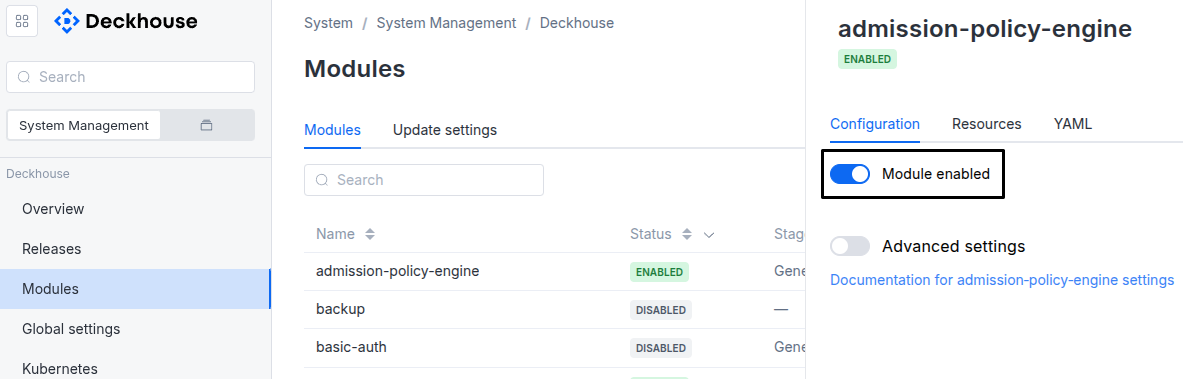
Via Deckhouse web UI. In the “System” → “System Management” → “Deckhouse” → “Modules” section, open the
csi-s3module and enable (or disable) the “Module enabled” toggle. Save changes.Example:
-
Via Deckhouse CLI (d8).
Use the d8 system module enable command for enabling, or d8 system module disable command for disabling the module (you need Deckhouse CLI (d8), configured to work with the cluster).
Example of enabling the module:
d8 system module enable csi-s3 -
Using ModuleConfig
csi-s3.Set
spec.enabledtotrueorfalsein ModuleConfigcsi-s3(create it if necessary).Example of a manifest to enable module
csi-s3:apiVersion: deckhouse.io/v1alpha1 kind: ModuleConfig metadata: name: csi-s3 spec: enabled: true
You can configure the module in one of the following ways:
-
Via Deckhouse web UI.
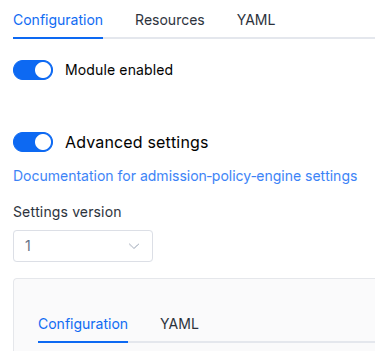
In the “System” → “System Management” → “Deckhouse” → “Modules” section, open the
csi-s3module and enable the “Advanced Settings” toggle. Fill in the required fields in the “Configuration” tab or specify the module settings in YAML format on the “YAML” tab, without the top-levelsettingskey. Save the changes.Example:
You can also edit the ModuleConfig object
csi-s3on the “YAML” tab in the module settings window (“System” → “System Management” → “Deckhouse” → “Modules”, open the modulecsi-s3) by specifying the schema version in thespec.versionparameter and the necessary module parameters in thespec.settingssection. -
Via Deckhouse CLI (d8) (requires Deckhouse CLI (d8) configured to work with the cluster).
Edit the existing ModuleConfig
csi-s3(for more details on configuring Deckhouse Platform, see the documentation) by executing the following command:d8 k edit mc csi-s3Make the necessary changes in the
spec.settingssection. If necessary, specify the schema version in thespec.versionparameter. Save the changes.You can also create a manifest file for ModuleConfig
csi-s3using the example below. Fill in thespec.settingssection with the required module parameters. If necessary, specify the schema version in thespec.versionparameter.Apply the manifest using the following command (indicate the manifest file name):
d8 k apply -f <FILENAME>Example of a manifest for ModuleConfig
csi-s3:apiVersion: deckhouse.io/v1alpha1 kind: ModuleConfig metadata: name: csi-s3 spec: version: 1 enabled: true settings: # Module parameters from the "Parameters" section below.
Requirements
To the Deckhouse Platform version: 1.72 and above.
Parameters
Schema version: 1
-
-
array of stringssettings.customCACertificates
Additional Certification Authority (CA) certificates trusted by the module when connecting to HTTPS endpoints of an S3-compatible storage.
Each list item must contain a CA X.509 certificate in PEM format, either as PEM text or Base64-encoded. Invalid values are rejected by the validating webhook before the parameter is applied by the module.
Use this parameter if the TLS certificate of the object storage is signed by a private or corporate Certification Authority that is not included in the module’s default trusted certificate bundle.
Default:
[] -
objectsettings.dataNodesSettings for CSI S3 on nodes where volumes can be mounted
Default:
{}-
objectsettings.dataNodes.nodeSelector
The same as in the Pods
spec.nodeSelectorparameter in Kubernetes.By default (
kubernetes.io/os: linux), thecsi-nodeDaemonSet runs on every Linux node. Override this to restrict CSI S3 to a subset of nodes. An empty object is rejected by the validating webhook to avoid accidentally matching every node in the cluster.Caution! Changing this parameter does not migrate existing mounts. If a node no longer matches the
nodeSelector, volumes on that node will become inaccessible.Default:
{
 "kubernetes.io/os": "linux"
}
-
-
stringsettings.logLevel
Sets log verbosity for the CSI S3 controller process.
The verbosity of logging decreases from
TRACEtoERROR:TRACEandDEBUGare intended for in-depth troubleshooting,INFOreflects normal operation,WARNhighlights unusual but non-fatal situations, andERRORrecords failures only.Default:
INFOAllowed values:
ERROR,WARN,INFO,DEBUG,TRACE -
array of stringssettings.storageClassLabelIgnoredPrefixes
List of label-key prefixes that MUST NOT be propagated from an S3StorageClass to the managed Kubernetes StorageClass.
The controller treats this list as a complement to a built-in (system) list and drops any S3StorageClass label whose key starts with any prefix from either list.
The defaults cover labels typically added by GitOps tooling (Argo CD, Flux, Rancher Fleet) so that their reconcilers do not fight the storage controller over labels on the managed StorageClass.
Default:
[
 "argocd.argoproj.io/",
 "kustomize.toolkit.fluxcd.io/",
 "helm.toolkit.fluxcd.io/",
 "fleet.cattle.op/"
]
-