Available in editions: Open/CE, BE, SE, SE+, Ultimate/EE, Core
Included in extensions: Advanced Infrastructure Security, Billing
The module lifecycle stage: Preview
To configure connection parameters to the container registry and manage the container registry operating mode, use the registry section of the deckhouse module configuration.
The parameters of the registry module itself are specified in ModuleConfig registry.
The module is enabled by default in the Default bundle.
The module is disabled by default in the following bundles: Managed, Minimal.
How to explicitly enable the module...
You may explicitly enable or disable the module in one of the following ways:
-
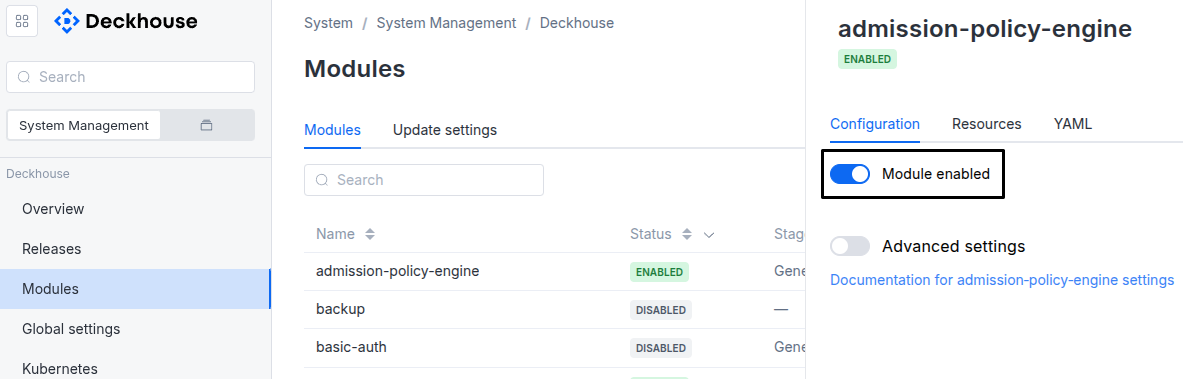
Via Deckhouse web UI. In the “System” → “System Management” → “Deckhouse” → “Modules” section, open the
registrymodule and enable (or disable) the “Module enabled” toggle. Save changes.Example:
-
Via Deckhouse CLI (d8).
Use the d8 system module enable command for enabling, or d8 system module disable command for disabling the module (you need Deckhouse CLI (d8), configured to work with the cluster).
Example of enabling the module:
d8 system module enable registry -
Using ModuleConfig
registry.Set
spec.enabledtotrueorfalsein ModuleConfigregistry(create it if necessary);Example of a manifest to enable module
registry:apiVersion: deckhouse.io/v1alpha1 kind: ModuleConfig metadata: name: registry spec: enabled: true
How to configure the module...
You can configure the module in one of the following ways:
-
Via Deckhouse web UI.
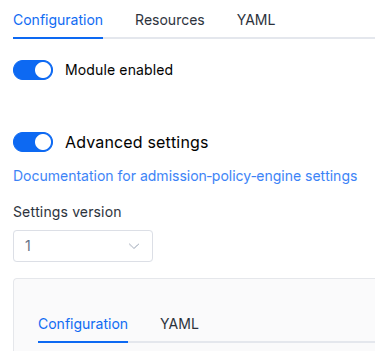
In the “System” → “System Management” → “Deckhouse” → “Modules” section, open the
registrymodule and enable the “Advanced Settings” switch. Fill in the required fields in the “Configuration” tab or specify the module settings in YAML format on the “YAML” tab, excluding the settings section. Save the changes.Example:
You can also edit the ModuleConfig object
registryon the “YAML” tab in the module settings window (“System” → “System Management” → “Deckhouse” → “Modules”, open the moduleregistry) by specifying the schema version in thespec.versionparameter and the necessary module parameters in thespec.settingssection. -
Via Deckhouse CLI (d8) (requires Deckhouse CLI (d8) configured to work with the cluster).
Edit the existing ModuleConfig
registry(for more details on configuring Deckhouse, see the documentation) by executing the following command:d8 k edit mc registryMake the necessary changes in the
spec.settingssection. If necessary, specify the schema version in thespec.versionparameter. Save the changes.You can also create a file with manifest for ModuleConfig
registryusing the example below. Fill in thespec.settingssection with the required module parameters. If necessary, specify the schema version in thespec.versionparameter.Apply the manifest using the following command (indicate the manifest file name):
d8 k apply -f <FILENAME>Example of a manifest for ModuleConfig
registry:apiVersion: deckhouse.io/v1alpha1 kind: ModuleConfig metadata: name: registry spec: version: 1 enabled: true settings: # Module parameters from the "Parameters" section below.
Parameters
Schema version: 1
- objectsettings
- objectsettings.https
What certificate type to use.
This parameter completely overrides the
global.modules.httpssettings.Examples:
https: mode: Disabledhttps: mode: OnlyInURIhttps: mode: CustomCertificate customCertificate: secretName: foobarhttps: mode: CertManager certManager: clusterIssuerName: letsencrypt- objectsettings.https.certManager
Parameters for certmanager.
- stringsettings.https.certManager.clusterIssuerName
What ClusterIssuer to use for getting an SSL certificate (currently,
letsencrypt,letsencrypt-staging,selfsignedare available; also, you can define your own).Default:
letsencryptExample:
clusterIssuerName: letsencrypt
- objectsettings.https.customCertificate
Parameters for custom certificate usage.
- stringsettings.https.customCertificate.secretName
The name of the secret in the
d8-systemnamespace to use with the registry ingress.This secret must have the kubernetes.io/tls format.
- stringsettings.https.mode
The HTTPS usage mode:
CertManager: The registry ingress is accessed over HTTPS using a certificate obtained from a clusterIssuer specified in thecertManager.clusterIssuerNameparameter.CustomCertificate: The registry ingress is accessed over HTTPS using a certificate from thed8-systemnamespace.Disabled: In this mode, the registry ingress can only be accessed over HTTP.OnlyInURI: The registry ingress will work over HTTP (thinking that there is an external HTTPS load balancer in front of it that terminates HTTPS traffic). Load balancer should provide a redirect from HTTP to HTTPS.
Default:
CertManagerAllowed values:
Disabled,CertManager,CustomCertificate,OnlyInURI
- stringsettings.ingressClass
The class of the Ingress controller used for the registry.
Optional. By default, the
modules.ingressClassglobal value is used.Pattern:
^[a-z0-9]([-a-z0-9]*[a-z0-9])?(\.[a-z0-9]([-a-z0-9]*[a-z0-9])?)*$ - array of stringssettings.whitelistSourceRanges
A list of CIDR-formatted addresses allowed to connect to the registry. If not specified, connections from any address are allowed.
Example:
whitelistSourceRanges: - 10.0.0.0/10 - 192.168.0.0/16- stringElement of the array
Pattern:
^(([0-9]|[1-9][0-9]|1[0-9]{2}|2[0-4][0-9]|25[0-5])\.){3}([0-9]|[1-9][0-9]|1[0-9]{2}|2[0-4][0-9]|25[0-5])(\/(3[0-2]|[1-2][0-9]|[0-9]))?$