Available in: Ultimate/EE
Included in extensions: Advanced Infrastructure Security
The module lifecycle stage: Generally available version
The module has requirements for installation
How to explicitly enable or disable the module…
You may explicitly enable or disable the module in one of the following ways:
-
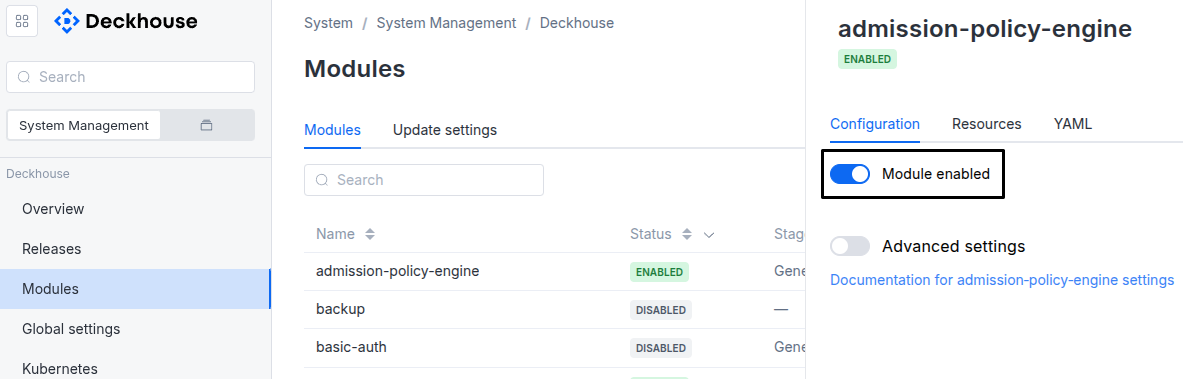
Via Deckhouse web UI. In the “System” → “System Management” → “Deckhouse” → “Modules” section, open the
runtime-audit-enginemodule and enable (or disable) the “Module enabled” toggle. Save changes.Example:
-
Via Deckhouse CLI (d8).
Use the d8 system module enable command for enabling, or d8 system module disable command for disabling the module (you need Deckhouse CLI (d8), configured to work with the cluster).
Example of enabling the module:
d8 system module enable runtime-audit-engine -
Using ModuleConfig
runtime-audit-engine.Set
spec.enabledtotrueorfalsein ModuleConfigruntime-audit-engine(create it if necessary).Example of a manifest to enable module
runtime-audit-engine:apiVersion: deckhouse.io/v1alpha1 kind: ModuleConfig metadata: name: runtime-audit-engine spec: enabled: true
You can configure the module in one of the following ways:
-
Via Deckhouse web UI.
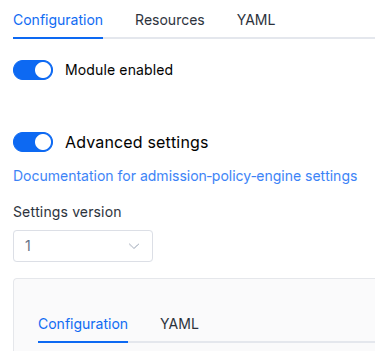
In the “System” → “System Management” → “Deckhouse” → “Modules” section, open the
runtime-audit-enginemodule and enable the “Advanced Settings” toggle. Fill in the required fields in the “Configuration” tab or specify the module settings in YAML format on the “YAML” tab, without the top-levelsettingskey. Save the changes.Example:
You can also edit the ModuleConfig object
runtime-audit-engineon the “YAML” tab in the module settings window (“System” → “System Management” → “Deckhouse” → “Modules”, open the moduleruntime-audit-engine) by specifying the schema version in thespec.versionparameter and the necessary module parameters in thespec.settingssection. -
Via Deckhouse CLI (d8) (requires Deckhouse CLI (d8) configured to work with the cluster).
Edit the existing ModuleConfig
runtime-audit-engine(for more details on configuring Deckhouse Platform, see the documentation) by executing the following command:d8 k edit mc runtime-audit-engineMake the necessary changes in the
spec.settingssection. If necessary, specify the schema version in thespec.versionparameter. Save the changes.You can also create a manifest file for ModuleConfig
runtime-audit-engineusing the example below. Fill in thespec.settingssection with the required module parameters. If necessary, specify the schema version in thespec.versionparameter.Apply the manifest using the following command (indicate the manifest file name):
d8 k apply -f <FILENAME>Example of a manifest for ModuleConfig
runtime-audit-engine:apiVersion: deckhouse.io/v1alpha1 kind: ModuleConfig metadata: name: runtime-audit-engine spec: version: 1 enabled: true settings: # Module parameters from the "Parameters" section below.
Requirements
To the Kubernetes version: 1.31 and above.
To the Deckhouse Platform version: 1.74 and above.
Parameters
Schema version: 1
-
-
array of stringssettings.builtInRulesListList of enabled default rules. You can specify an empty list
[]to disable built-in rules.Default:
[
 "Fstec"
]
Examples:
builtInRulesList: - FstecbuiltInRulesList: []-
stringsettings.builtInRulesList.Element of the array
Allowed values:
Fstec
-
-
objectsettings.builtInRulesTypes
Disabling built-in rules by event source type.
By default, all built-in rule types are enabled. Set the corresponding sub-parameter to
falseto stop rendering rules of this type.Default:
{}Examples:
{}k8sAudit: falsesyscall: falsek8sAudit: false syscall: false-
booleansettings.builtInRulesTypes.k8sAudit
If
false, built-in rules with theK8sAuditsource are not rendered.When the
security-events-managermodule is enabled, built-inK8sAuditrules are automatically disabled to avoid duplication. Setting this parameter totrueexplicitly overrides this behavior and keeps the rules rendered.Default:
true -
booleansettings.builtInRulesTypes.syscallIf
false, built-in rules with theSyscallsource (used by default whensourceis not specified) are not rendered.Default:
true
-
-
booleansettings.debugLoggingIf true, all events will be duplicated to stdout.
-
objectsettings.resourcesRequests
Max amounts of CPU and memory resources that the pod can request when selecting a node.
If the
vertical-pod-autoscalermodule is disabled, then these values become the default ones.Default:
{}Examples:
mode: VPA vpa: cpu: max: 2 min: 50m memory: max: 2Gi min: 256Mi mode: Automode: VPA vpa: cpu: max: 3000m min: 1 memory: max: 4096 min: 1024 mode: Initialmode: Static static: cpu: 55m memory: 256Ki-
settings.resourcesRequests.limitRange
Configuration for LimitRange that constrains container resources in the module namespace. Used as a safety net to prevent unbounded resource consumption (e.g., due to memory leaks).
This parameter is optional:
- set
falseto disable LimitRange explicitly; - set an object with settings to create LimitRange.
Default:
falseExamples:
limitRange: falsecontainerDefaultRequest: memory: 64Mi containerMax: memory: 1Gi containerMin: memory: 64MicontainerDefault: cpu: 500m memory: 512Mi containerDefaultRequest: cpu: 100m memory: 64Mi containerMax: cpu: '2' memory: 2Gi containerMin: cpu: 50m memory: 64Mi - set
-
stringsettings.resourcesRequests.mode
Required value
Resource request management mode:
Default:
VPAAllowed values:
VPA,Static -
objectsettings.resourcesRequests.staticResource request management options for the
Staticmode.Default:
{}-
settings.resourcesRequests.static.cpu
Required value
Configuring CPU requests.Default:
50m -
settings.resourcesRequests.static.memory
Required value
Configuring memory requests.Default:
64Mi
-
-
objectsettings.resourcesRequests.vpaResource request management options for the VPA mode.
Default:
{}-
objectsettings.resourcesRequests.vpa.cpu
Required value
CPU-related parameters.Default:
{}-
settings.resourcesRequests.vpa.cpu.maxThe maximum value that the VPA can set for the CPU requests.
Default:
4000m -
settings.resourcesRequests.vpa.cpu.minThe minimum value that the VPA can set for the CPU requests.
Default:
50m
-
-
objectsettings.resourcesRequests.vpa.memory
Required value
The amount of memory requested.Default:
{}-
settings.resourcesRequests.vpa.memory.maxThe maximum memory requests the VPA can set.
Default:
5Gi -
settings.resourcesRequests.vpa.memory.minThe minimum memory requests the VPA can set.
Default:
64Mi
-
-
stringsettings.resourcesRequests.vpa.mode
Required value
The VPA usage mode.Default:
InitialAllowed values:
Initial,Auto -
stringsettings.resourcesRequests.vpa.scopeLabelNode label key used by VPA to split DaemonSet pods into subgroups for per-group resource recommendations.
Default:
node.deckhouse.io/groupPattern:
^([a-z0-9]([-a-z0-9]*[a-z0-9])?(\.[a-z0-9]([-a-z0-9]*[a-z0-9])?)*/)?[A-Za-z0-9]([-A-Za-z0-9_.]*[A-Za-z0-9])?$
-
-
-