Available in editions: Open/CE, BE, SE, SE+, Ultimate/EE, Core
The module lifecycle stage: General Availability
The module has 10 alerts.
The module is enabled by default in the Default bundle.
The module is disabled by default in the following bundles: Managed, Minimal.
How to explicitly enable the module...
You may explicitly enable or disable the module in one of the following ways:
-
Via Deckhouse web UI. In the “System” → “System Management” → “Deckhouse” → “Modules” section, open the
terraform-managermodule and enable (or disable) the “Module enabled” toggle. Save changes.Example:
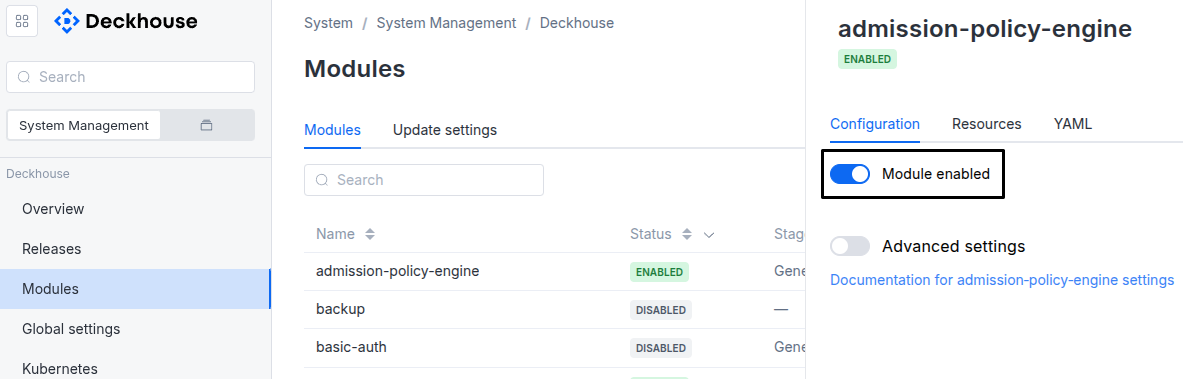
-
Via Deckhouse CLI (d8).
Use the d8 system module enable command for enabling, or d8 system module disable command for disabling the module (you need Deckhouse CLI (d8), configured to work with the cluster).
Example of enabling the module:
d8 system module enable terraform-manager -
Using ModuleConfig
terraform-manager.Set
spec.enabledtotrueorfalsein ModuleConfigterraform-manager(create it if necessary);Example of a manifest to enable module
terraform-manager:apiVersion: deckhouse.io/v1alpha1 kind: ModuleConfig metadata: name: terraform-manager spec: enabled: true
How to configure the module...
You can configure the module in one of the following ways:
-
Via Deckhouse web UI.
In the “System” → “System Management” → “Deckhouse” → “Modules” section, open the
terraform-managermodule and enable the “Advanced Settings” switch. Fill in the required fields in the “Configuration” tab or specify the module settings in YAML format on the “YAML” tab, excluding the settings section. Save the changes.Example:
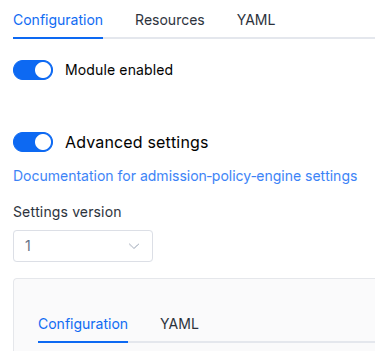
You can also edit the ModuleConfig object
terraform-manageron the “YAML” tab in the module settings window (“System” → “System Management” → “Deckhouse” → “Modules”, open the moduleterraform-manager) by specifying the schema version in thespec.versionparameter and the necessary module parameters in thespec.settingssection. -
Via Deckhouse CLI (d8) (requires Deckhouse CLI (d8) configured to work with the cluster).
Edit the existing ModuleConfig
terraform-manager(for more details on configuring Deckhouse, see the documentation) by executing the following command:d8 k edit mc terraform-managerMake the necessary changes in the
spec.settingssection. If necessary, specify the schema version in thespec.versionparameter. Save the changes.You can also create a file with manifest for ModuleConfig
terraform-managerusing the example below. Fill in thespec.settingssection with the required module parameters. If necessary, specify the schema version in thespec.versionparameter.Apply the manifest using the following command (indicate the manifest file name):
d8 k apply -f <FILENAME>Example of a manifest for ModuleConfig
terraform-manager:apiVersion: deckhouse.io/v1alpha1 kind: ModuleConfig metadata: name: terraform-manager spec: version: 1 enabled: true settings: # Module parameters from the "Parameters" section below.
Parameters
Schema version: 1
- objectsettings
- booleansettings.autoConvergerEnabled
Enables periodic checking of Terraform state and applying non-destructive changes.
The frequency of the check is set by the autoConvergerPeriod parameter.
Default:
true - stringsettings.autoConvergerPeriod
The time interval after which the state of Terraform is checked and applied.
It is specified as a string containing the time unit in hours and minutes: 30m, 1h, 2h30m, 24h.
Default:
1hPattern:
^([0-9]+h)?([0-9]+m)?([0-9]+s)?$ - objectsettings.nodeSelector
The same as in the Pod’s
spec.nodeSelectorparameter in Kubernetes.If the parameter is omitted or
false, it will be determined automatically. - array of objectssettings.tolerations
The same as in the Pods’
spec.tolerationsparameter in Kubernetes;If the parameter is omitted or
false, it will be determined automatically.- stringsettings.tolerations.effect
- stringsettings.tolerations.key
- stringsettings.tolerations.operator
- integersettings.tolerations.tolerationSeconds
- stringsettings.tolerations.value