Available in editions: Open/CE, BE, SE, SE+, Ultimate/EE, Core
The module lifecycle stage: General Availability
The module has 7 alerts.
The module is not enabled by default in any bundles.
How to explicitly enable the module...
You may explicitly enable or disable the module in one of the following ways:
-
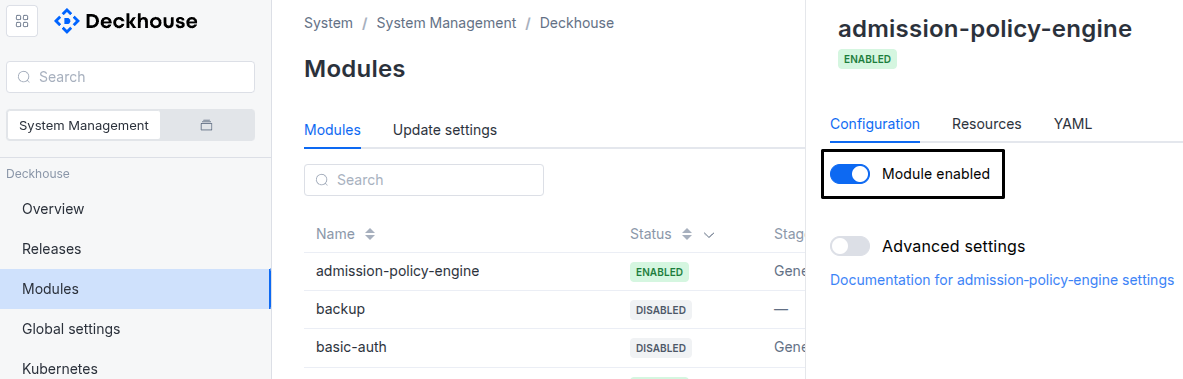
Via Deckhouse web UI. In the “System” → “System Management” → “Deckhouse” → “Modules” section, open the
cni-flannelmodule and enable (or disable) the “Module enabled” toggle. Save changes.Example:
-
Via Deckhouse CLI (d8).
Use the d8 system module enable command for enabling, or d8 system module disable command for disabling the module (you need Deckhouse CLI (d8), configured to work with the cluster).
Example of enabling the module:
d8 system module enable cni-flannel -
Using ModuleConfig
cni-flannel.Set
spec.enabledtotrueorfalsein ModuleConfigcni-flannel(create it if necessary);Example of a manifest to enable module
cni-flannel:apiVersion: deckhouse.io/v1alpha1 kind: ModuleConfig metadata: name: cni-flannel spec: enabled: true
How to configure the module...
You can configure the module in one of the following ways:
-
Via Deckhouse web UI.
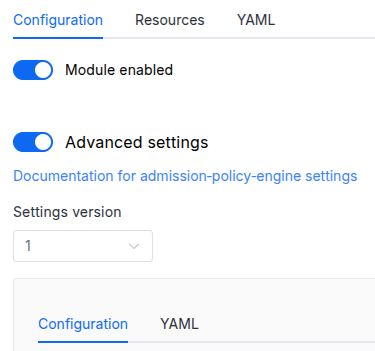
In the “System” → “System Management” → “Deckhouse” → “Modules” section, open the
cni-flannelmodule and enable the “Advanced Settings” switch. Fill in the required fields in the “Configuration” tab or specify the module settings in YAML format on the “YAML” tab, excluding the settings section. Save the changes.Example:
You can also edit the ModuleConfig object
cni-flannelon the “YAML” tab in the module settings window (“System” → “System Management” → “Deckhouse” → “Modules”, open the modulecni-flannel) by specifying the schema version in thespec.versionparameter and the necessary module parameters in thespec.settingssection. -
Via Deckhouse CLI (d8) (requires Deckhouse CLI (d8) configured to work with the cluster).
Edit the existing ModuleConfig
cni-flannel(for more details on configuring Deckhouse, see the documentation) by executing the following command:d8 k edit mc cni-flannelMake the necessary changes in the
spec.settingssection. If necessary, specify the schema version in thespec.versionparameter. Save the changes.You can also create a file with manifest for ModuleConfig
cni-flannelusing the example below. Fill in thespec.settingssection with the required module parameters. If necessary, specify the schema version in thespec.versionparameter.Apply the manifest using the following command (indicate the manifest file name):
d8 k apply -f <FILENAME>Example of a manifest for ModuleConfig
cni-flannel:apiVersion: deckhouse.io/v1alpha1 kind: ModuleConfig metadata: name: cni-flannel spec: version: 1 enabled: true settings: # Module parameters from the "Parameters" section below.
Parameters
Schema version: 1
- objectsettings
- objectsettings.ipv4OptionsGuard
Mitigation of CVE-2026-98432 (use-after-free in the Linux IPv4 TCP handshake triggered by a TCP SYN with IP options).
A sidecar of the CNI agent installs a filter into the host network namespace and into every pod network namespace on the node, including pods started later. The filter matches IPv4 TCP SYN packets and IPv4 fragments carrying IP options.
The filter follows the iptables mode (nft or legacy) that iptables-wrapper selects on the node, the same as the other Deckhouse components. In the nft mode, the filter uses native nftables expressions. In the legacy mode, it uses iptables with the
u32match. No kernel modules are loaded unlessallowKernelModuleLoadis set. If the kernel modules of the selected mode are not loaded but those of the other mode are, the filter uses the other mode, and the node is reported by theD8IPv4OptionsGuardBackendMismatchalert. A node that cannot be protected is reported by theD8IPv4OptionsGuardNodeUnprotectedalert.To exclude a node (for example, a node with CIPSO labeled networking), set the
ipv4-options-guard.deckhouse.io/disabled: "true"label on it: the changes are reverted on that node.The mitigation does not fix the vulnerability: update the node kernel as soon as a fixed version is available.
- booleansettings.ipv4OptionsGuard.allowKernelModuleLoad
The filter needs the
nf_tableskernel module in the nft mode and theip_tables,iptable_raw,xt_tcpudpandxt_u32kernel modules in the legacy mode.By default, kernel modules are not loaded: if a module of the mode selected by iptables-wrapper is not loaded, the filter uses the other mode when its modules are loaded, and the node is reported as unprotected otherwise. Set to
trueto load the modules of the selected mode.Default:
false - booleansettings.ipv4OptionsGuard.disableMPTCP
In the
Enforcemode, setnet.mptcp.enabled=0in the host and in every pod network namespace. This removes the precondition of the published exploit.Listeners opened before the change stay MPTCP until the process is restarted. After a node reboot, MPTCP on the host is disabled again once the CNI agent starts.
Default:
true - stringsettings.ipv4OptionsGuard.mode
Operating mode.
If the mode is not set, it is
Enforcein clusters installed with the mitigation andAuditin clusters that existed before it.Audit— matching packets are only counted (thed8_ipv4_options_guard_matched_packets_totalmetric and theD8IPv4OptionsGuardMatchedTrafficalert). Use it to check that no workload relies on IP options. While any node is in this mode, theD8IPv4OptionsGuardAuditModealert reminds that the cluster is not protected yet.Enforce— matching packets are dropped, and MPTCP is disabled ifdisableMPTCPis set.Disabled— the filter is removed from all network namespaces, including running pods, andnet.mptcp.enabledis restored to the value it had before.
The mode is applied without restarting the CNI agent pods.
Allowed values:
Audit,Enforce,Disabled
- stringsettings.podNetworkMode
Work mode.
NOTE! All cluster nodes must be rebooted after switching work mode. You can change the parameter only in bare metal clusters.
Default:
HostGWAllowed values:
HostGW,VXLAN