Available in: Ultimate/EE
The module lifecycle stage: Generally available version
The module has requirements for installation
How to explicitly enable or disable the module…
You may explicitly enable or disable the module in one of the following ways:
-
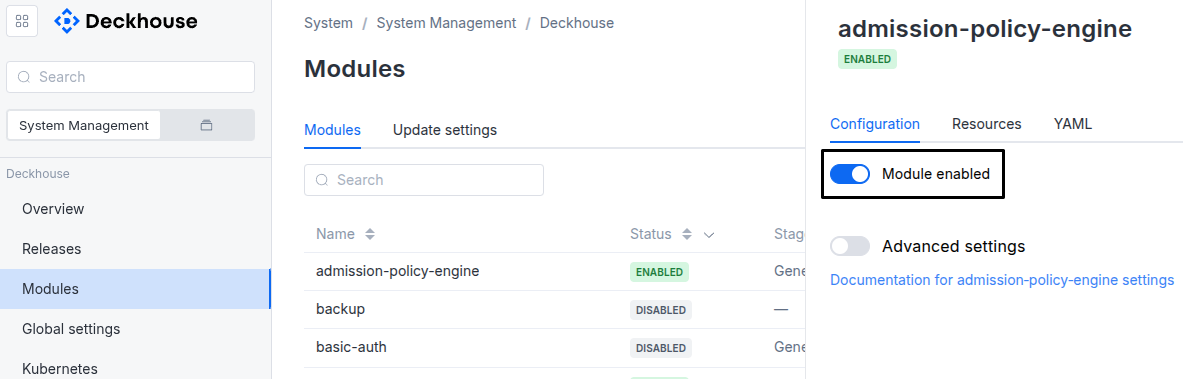
Via Deckhouse web UI. In the “System” → “System Management” → “Deckhouse” → “Modules” section, open the
development-platformmodule and enable (or disable) the “Module enabled” toggle. Save changes.Example:
-
Via Deckhouse CLI (d8).
Use the d8 system module enable command for enabling, or d8 system module disable command for disabling the module (you need Deckhouse CLI (d8), configured to work with the cluster).
Example of enabling the module:
d8 system module enable development-platform -
Using ModuleConfig
development-platform.Set
spec.enabledtotrueorfalsein ModuleConfigdevelopment-platform(create it if necessary).Example of a manifest to enable module
development-platform:apiVersion: deckhouse.io/v1alpha1 kind: ModuleConfig metadata: name: development-platform spec: enabled: true
You can configure the module in one of the following ways:
-
Via Deckhouse web UI.
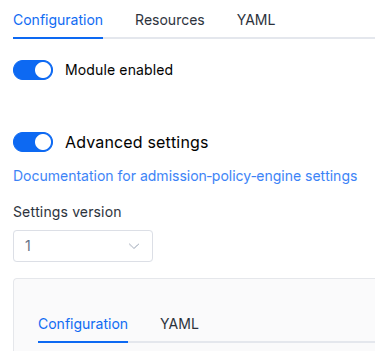
In the “System” → “System Management” → “Deckhouse” → “Modules” section, open the
development-platformmodule and enable the “Advanced Settings” toggle. Fill in the required fields in the “Configuration” tab or specify the module settings in YAML format on the “YAML” tab, without the top-levelsettingskey. Save the changes.Example:
You can also edit the ModuleConfig object
development-platformon the “YAML” tab in the module settings window (“System” → “System Management” → “Deckhouse” → “Modules”, open the moduledevelopment-platform) by specifying the schema version in thespec.versionparameter and the necessary module parameters in thespec.settingssection. -
Via Deckhouse CLI (d8) (requires Deckhouse CLI (d8) configured to work with the cluster).
Edit the existing ModuleConfig
development-platform(for more details on configuring Deckhouse Platform, see the documentation) by executing the following command:d8 k edit mc development-platformMake the necessary changes in the
spec.settingssection. If necessary, specify the schema version in thespec.versionparameter. Save the changes.You can also create a manifest file for ModuleConfig
development-platformusing the example below. Fill in thespec.settingssection with the required module parameters. If necessary, specify the schema version in thespec.versionparameter.Apply the manifest using the following command (indicate the manifest file name):
d8 k apply -f <FILENAME>Example of a manifest for ModuleConfig
development-platform:apiVersion: deckhouse.io/v1alpha1 kind: ModuleConfig metadata: name: development-platform spec: version: 1 enabled: true settings: # Module parameters from the "Parameters" section below.
Requirements
To the Deckhouse Platform version: 1.72 and above.
Parameters
Schema version: 1
-
-
objectsettings.actions
Default:
{}-
objectsettings.actions.logging
Default:
{}-
booleansettings.actions.logging.enabledFlag to enable or disable action logging to stdout.
Default:
false
-
-
-
array of stringssettings.additionalImagePullSecretsAdditional image pull secret names that will be added to
registry-credsfor all containers (backend, workers, frontend, postgres, redis).Default:
[]Examples:
additionalImagePullSecrets: []additionalImagePullSecrets: - custom-registry-secretadditionalImagePullSecrets: - additional-secret-1 - additional-secret-2 -
objectsettings.datasources
Default:
{}-
objectsettings.datasources.logging
Default:
{}-
booleansettings.datasources.logging.enabledFlag to enable or disable datasource logging to stdout.
Default:
false
-
-
-
objectsettings.domain
Default:
{}-
stringsettings.domain.customDomainThe custom domain to use if
useCustomDomainis true. Must not contain http:// or https://. Required ifuseCustomDomainis true.Default:
example.comExamples:
customDomain: example.comcustomDomain: ddp.example.com -
stringsettings.domain.customSecretNameThe custom secret name to use if
useCustomSecretis true.Default:
example-tlsExamples:
customSecretName: example-tlscustomSecretName: custom-tls-secret -
stringsettings.domain.prefixPrefix for generating the domain name if not using a custom domain.
Default:
ddpExamples:
prefix: ddpprefix: dev-platform -
booleansettings.domain.useCustomDomainIf true, use the custom domain. If false, use the generated domain prefix.
Default:
false -
booleansettings.domain.useCustomSecretUse custom secret
Default:
false
-
-
objectsettings.events
Default:
{}-
stringsettings.events.ttlTime to live for events. Format: string in Go duration format.
Default:
96hExamples:
ttl: 96httl: 720httl: 1dttl: 30m
-
-
stringsettings.extraCAAdditional CA certificates in PEM format. Used when accessing any services that DDP may potentially connect to (e.g., dex by FQDN if you have your own CA for dex). The certificate is mounted to
/etc/ssl/certs/extraca.crt.Default:
‘’Examples:
extraCA: ''extraCA: | -----BEGIN CERTIFICATE----- MIIEKTCCApGgAwIBAgIRAL6BA5jjXYI52wcc3b9UftAwDQYJKoZIhvcNAQELBQAw ... -----END CERTIFICATE----- -
objectsettings.logger
Default:
{}-
stringsettings.logger.formatFormat of the logging.
Default:
logfmtAllowed values:
json,logfmt -
stringsettings.logger.levelLogging level.
Default:
infoAllowed values:
debug,info,warn,error
-
-
objectsettings.postgres
Default:
{}-
stringsettings.postgres.databaseName of the Postgres database.
Default:
ddpExamples:
database: ddpdatabase: development_platformdatabase: my_database -
stringsettings.postgres.hostHostname or IP address of the Postgres server. When
mode=internal, must be set topostgres.Default:
postgresExamples:
host: postgreshost: localhosthost: 192.168.1.100host: postgres.example.com -
stringsettings.postgres.imageDocker image for Postgres container. Used when
mode=internal. Can include registry prefix (e.g.,registry.example.com/postgres:16.3).Default:
postgres:16.3Examples:
image: postgres:16.3image: registry.example.com/postgres:18.1image: my-registry.io/postgres:16.3 -
stringsettings.postgres.modeSpecifies whether Postgres is internal or external.
Default:
internalAllowed values:
internal,external -
stringsettings.postgres.passwordPassword for connecting to Postgres.
Default:
ddpExamples:
password: ddppassword: secure_password_123 -
numbersettings.postgres.portPort number on which Postgres is listening. Not required if using the default value.
Default:
5432Examples:
port: 5432port: 35432 -
stringsettings.postgres.usernameUsername for connecting to Postgres.
Default:
ddpExamples:
username: ddpusername: postgresusername: db_user
-
-
objectsettings.rbac
Default:
{}-
booleansettings.rbac.ownerIsAdminIf true, the resource owner automatically gets administrator rights.
Default:
true -
stringsettings.rbac.superAdminEmail
Required value
Email of the super admin.Example:
superAdminEmail: admin@example.com
-
-
objectsettings.redis
Default:
{}-
stringsettings.redis.databaseDatabase index to use on the Redis server. Not required if using the default value.
Default:
0Examples:
database: '0'database: '1'database: '15' -
stringsettings.redis.hostHostname or IP address of the Redis server. When
mode=internal, must be set toredis.Default:
redisExamples:
host: redishost: localhosthost: 192.168.1.101host: redis.example.com -
stringsettings.redis.imageDocker image for Redis container. Used when
mode=internal. Can include registry prefix (e.g.,registry.example.com/redis:7.4.0).Default:
redis:7.4.0Examples:
image: redis:7.4.0image: registry.example.com/redis:8.4.0image: my-registry.io/redis:7.4.0 -
stringsettings.redis.modeSpecifies whether Redis is internal or external.
Default:
internalAllowed values:
internal,external -
stringsettings.redis.passwordPassword for connecting to Redis. Not required if using the default value (empty string).
Default:
‘’Examples:
password: ''password: redis_password -
numbersettings.redis.portPort number on which Redis is listening. Not required if using the default value.
Default:
6379Examples:
port: 6379port: 6380
-
-
objectsettings.security
Default:
{}-
objectsettings.security.headersConfiguration for HTTP security headers (CSP, X-Frame-Options, etc.).
Default:
{}-
objectsettings.security.headers.cspContent Security Policy (CSP) configuration.
Default:
{}-
stringsettings.security.headers.csp.additionalSourcesAdditional CSP sources (space-separated list of URLs or special values). These sources will be added to img-src, connect-src, frame-src, and frame-ancestors directives.
Default:
‘’Examples:
additionalSources: ''additionalSources: https://cdn.example.comadditionalSources: https://api.example.com https://cdn.example.com -
booleansettings.security.headers.csp.allowExternalImagesAllow images from external sources. When true, images can be loaded from any domain (useful for icons from external CDNs). When false, only images from ‘self’ and ‘data:’ are allowed.
Default:
falseExamples:
allowExternalImages: falseallowExternalImages: true -
booleansettings.security.headers.csp.allowIframeAllow iframe embedding. When true, the application can be embedded in iframes from any domain (useful for widgets). When false, only same-origin iframes are allowed.
Default:
falseExamples:
allowIframe: falseallowIframe: true
-
-
booleansettings.security.headers.enabledEnable or disable security headers. When disabled, no security headers will be sent in HTTP responses.
Default:
trueExamples:
enabled: trueenabled: false -
stringsettings.security.headers.xFrameOptionsX-Frame-Options header value. ‘DENY’ prevents the page from being displayed in a frame. ‘SAMEORIGIN’ allows framing only by pages from the same origin.
Default:
SAMEORIGINAllowed values:
DENY,SAMEORIGINExamples:
xFrameOptions: DENYxFrameOptions: SAMEORIGIN
-
-
stringsettings.security.secretKey
Required value
Secret key for security purposes. Must contain 16, 24, or 32 characters (bytes). Only printable ASCII characters are allowed.Examples:
secretKey: mySecretKeyDefausecretKey: 16charssecretkeysecretKey: 24characterssecretkey!!xsecretKey: 32characterslongsecretkey1234xyz
-
-
objectsettings.workers
Default:
{}-
integersettings.workers.maxTasksMaximum number of tasks that can be processed in parallel by each worker. This controls the concurrency level per worker instance.
Default:
10Allowed values:
1 <= XExamples:
maxTasks: 5maxTasks: 10maxTasks: 20 -
integersettings.workers.replicasNumber of worker replicas to deploy. Workers process tasks from the queue (datasource sync, action execution, health checks).
Default:
2Allowed values:
0 <= XExamples:
replicas: 1replicas: 2replicas: 3
-
-