
The multitenancy-manager module allows you to create isolated projects within the Deckhouse Platform (DP). Projects provide resource quotas, network isolation, and security features that go beyond standard namespaces.
For more details about module configuration and usage examples, refer to the corresponding documentation section.
Internal logic
Project creation
The following custom resources are used to create a project:
- ProjectTemplate: Describes the project template. It defines the list of resources to be created in the project and the parameter schema that can be passed during project creation.
- Project: Describes a specific project.
When a Project is created from a specified ProjectTemplate, the following occurs:
- The provided parameters are validated against the OpenAPI specification
(defined in the
parametersSchema.openAPIV3Schemaparameter of the ProjectTemplate resource). - A namespace is created with the name of the Project.
- The project objects are created from the template. In a
deckhouse.io/v1alpha2template, settings such as the pod security profile, network isolation, log collection and node placement are described by structured fields, and the controller creates the corresponding objects in every namespace of the project. Other objects are described inmanifestsand are applied with the rights of thed8:project:adminrole in the project namespaces, not with the rights of the controller. A template with a Helm text inresourcesTemplateis rendered through Helm. This form is deprecated, no template can get a newresourcesTemplate, and a template is created throughdeckhouse.io/v1alpha2only. - The standard fields of the project are applied independently of the template:
.spec.quotais reconciled into a ResourceQuota, and.spec.administratorsinto an auto-managed ProjectRoleBinding.
If you modify a project template, all previously created projects will be updated according to the new template.
Project isolation
A namespace alone does not isolate a project. The project adds the following:
- Access to the whole project through
.spec.administrators, ProjectRoleBinding and ClusterProjectRoleBinding. A plain RoleBinding in one namespace is allowed for delegatable roles. - A resource limit through
.spec.quota, applied as thed8-project-quotaResourceQuota in the main namespace. - Network isolation through the
networkPolicy.mode: Isolatedfield of the template. - The pod security profile through the
podSecurityStandardfield of the template.
Managing access to cluster-wide resources
Objects in project namespaces can reference cluster-wide resources. For example, a PersistentVolumeClaim can use a StorageClass, a Certificate can use a ClusterIssuer, and a RoleBinding can use a ClusterRole. The module allows cluster administrators to define which cluster-wide resources can be used from project namespaces and which values are used by default.
This mechanism works independently of RBAC. RBAC determines who can create and modify objects, while the cluster-wide resource access mechanism determines which resources those objects can use.
The mechanism uses four custom resources:
- GrantableClusterResourceDefinition registers a type of cluster-wide resource whose access can be managed. These resources are provided by DP or module developers.
- GrantableClusterResourceReference defines where a registered cluster-wide resource is used, for example, which resource field contains a reference to it. These resources are provided by modules.
- ClusterResourceGrantPolicy defines access rules. In the
v1alpha2version, a cluster administrator selects the projects to which the policy applies by the labels of Project objects (projectSelector) and narrows the choice by the labels of project namespaces (namespaceSelector). The policy also defines the allowed and denied resources, as well as the resource used by default. - In every namespace of every project, the controller keeps an AvailableClusterResource for each GrantableClusterResourceDefinition. It lists the cluster-wide resources available to the project under the policies that apply and is read-only.
Until the administrator creates a ClusterResourceGrantPolicy, resource availability is determined by their registration: resources are available to all projects if defaultAvailability: All (the default value) is set in GrantableClusterResourceDefinition and the resource does not match the excluded or reserved filters.
Access checks are performed only for objects in project namespaces. If an access policy changes, cluster-wide resources already used by existing objects remain available to those objects.
The webhooks reject requests while the module controller is unavailable. Until it is back, objects of the registered kinds (for example, PersistentVolumeClaim, Service or RoleBinding) cannot be created or changed in project namespaces, except by the platform components and members of the system:masters group. To keep the controller available, enable highAvailability.
For a detailed description of the access management mechanism, refer to the multitenancy-manager module documentation.
Module architecture
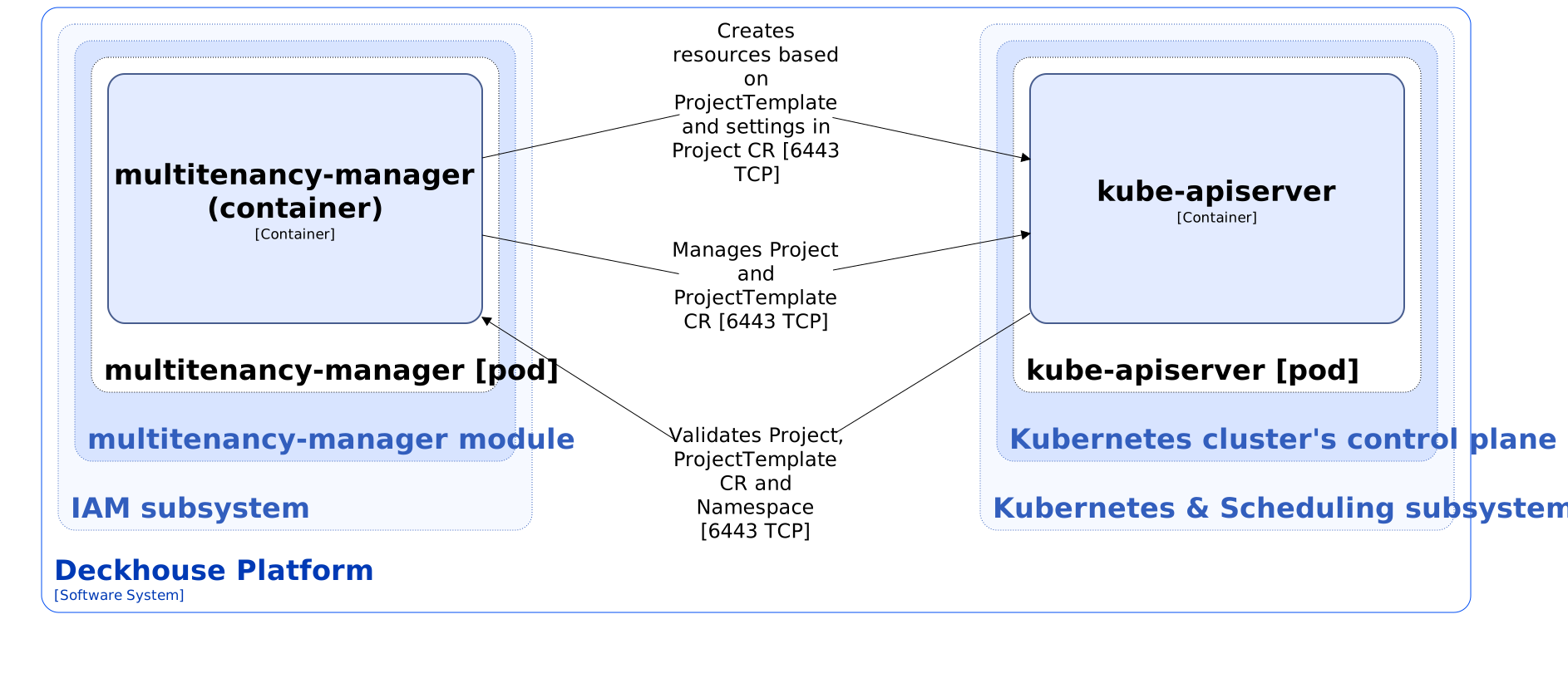
The following simplifications are made in the diagram:
- The diagram shows containers in different pods interacting directly with each other. In reality, they communicate via the corresponding Kubernetes Services (internal load balancers). Service names are omitted if they are obvious from the diagram context. Otherwise, the Service name is shown above the arrow.
- Pods may run multiple replicas. However, each pod is shown as a single replica in the diagram.
The architecture of the multitenancy-manager module at Level 2 of the C4 model and its interactions with other DP components are shown in the following diagram.
Module components
The module consists of the following components:
-
Multitenancy-manager: The component consists of a single multitenancy-manager container and provides the following functions:
- Managing the Project and ProjectTemplate custom resources.
- Validating the Project and ProjectTemplate custom resources.
- Creating the resources specified in the ProjectTemplate custom resource based on the parameters set in Project.
- Managing the grants mechanism for cluster-wide resources — the
GrantableClusterResourceDefinition,GrantableClusterResourceReference,ClusterResourceGrantPolicy, andAvailableClusterResourcecustom resources. It renders the per-project AvailableClusterResource catalogs and runs the validating and mutating admission webhooks (/is-granted,/defaults,/protect) that enforce which cluster resources a project may reference and substitute per-project defaults on CREATE.
Warning. Multitenancy-manager has
cluster-adminpermissions. Objects described in themanifestsfield of ProjectTemplate are applied not with these permissions but with the rights of thed8:project:adminrole in the project namespaces.
Module interactions
The module interacts with the following components:
- Kube-apiserver:
- Managing the Project and ProjectTemplate custom resources.
- Validating the Project and ProjectTemplate custom resources.
- Creating the resources specified in the ProjectTemplate custom resource based on the parameters set in Project.
- Managing the GrantableClusterResourceDefinition, GrantableClusterResourceReference, ClusterResourceGrantPolicy, and AvailableClusterResource custom resources.
- Validating the AvailableClusterResource custom resources.
- Creating validation admission webhooks based on conditions in GrantableClusterResourceDefinition and GrantableClusterResourceReference custom resources.