Available in editions: Open/CE, BE, SE, SE+, Ultimate/EE, Core
The module lifecycle stage: General Availability
The module has 37 alerts.
The module is enabled by default in the Default bundle.
The module is disabled by default in the following bundles: Managed, Minimal.
How to explicitly enable the module...
You may explicitly enable or disable the module in one of the following ways:
-
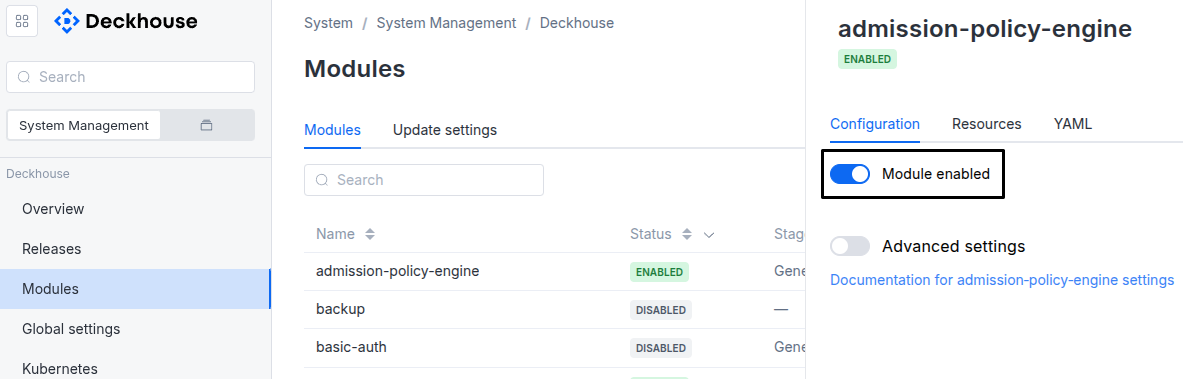
Via Deckhouse web UI. In the “System” → “System Management” → “Deckhouse” → “Modules” section, open the
node-managermodule and enable (or disable) the “Module enabled” toggle. Save changes.Example:
-
Via Deckhouse CLI (d8).
Use the d8 system module enable command for enabling, or d8 system module disable command for disabling the module (you need Deckhouse CLI (d8), configured to work with the cluster).
Example of enabling the module:
d8 system module enable node-manager -
Using ModuleConfig
node-manager.Set
spec.enabledtotrueorfalsein ModuleConfignode-manager(create it if necessary);Example of a manifest to enable module
node-manager:apiVersion: deckhouse.io/v1alpha1 kind: ModuleConfig metadata: name: node-manager spec: enabled: true
How to configure the module...
You can configure the module in one of the following ways:
-
Via Deckhouse web UI.
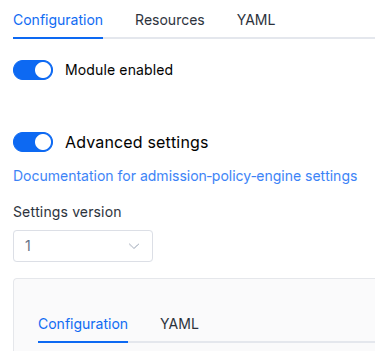
In the “System” → “System Management” → “Deckhouse” → “Modules” section, open the
node-managermodule and enable the “Advanced Settings” switch. Fill in the required fields in the “Configuration” tab or specify the module settings in YAML format on the “YAML” tab, excluding the settings section. Save the changes.Example:
You can also edit the ModuleConfig object
node-manageron the “YAML” tab in the module settings window (“System” → “System Management” → “Deckhouse” → “Modules”, open the modulenode-manager) by specifying the schema version in thespec.versionparameter and the necessary module parameters in thespec.settingssection. -
Via Deckhouse CLI (d8) (requires Deckhouse CLI (d8) configured to work with the cluster).
Edit the existing ModuleConfig
node-manager(for more details on configuring Deckhouse, see the documentation) by executing the following command:d8 k edit mc node-managerMake the necessary changes in the
spec.settingssection. If necessary, specify the schema version in thespec.versionparameter. Save the changes.You can also create a file with manifest for ModuleConfig
node-managerusing the example below. Fill in thespec.settingssection with the required module parameters. If necessary, specify the schema version in thespec.versionparameter.Apply the manifest using the following command (indicate the manifest file name):
d8 k apply -f <FILENAME>Example of a manifest for ModuleConfig
node-manager:apiVersion: deckhouse.io/v1alpha1 kind: ModuleConfig metadata: name: node-manager spec: version: 2 enabled: true settings: # Module parameters from the "Parameters" section below.
Conversions
The module is configured using the ModuleConfig resource, the schema of which contains a version number. When you apply an old version of the ModuleConfig schema in a cluster, automatic transformations are performed. To manually update the ModuleConfig schema version, the following steps must be completed sequentially for each version :
- Updates from version 1 to 2:
Delete
allowedKubernetesVersionsandallowedBundles.
Parameters
Schema version: 2
- objectsettings
- booleansettings.capiEmergencyBrake
Set to ‘true’ to disable CAPI in case of potentially cluster-damaging changes.
Warning. Use this flag only if you know why you are doing it and clearly understand the consequences.
Default:
falseExample:
capiEmergencyBrake: false - booleansettings.earlyOomEnabled
Set to ‘false’ to disable early OOM killer in case it behaves incorrectly.
Default:
trueExample:
earlyOomEnabled: false - stringsettings.instancePrefix
The prefix to use when creating instances via the corresponding cloud provider module.
The default value can be calculated based on the
ClusterConfigurationstruct if the cluster is installed via the Deckhouse installer.Example:
instancePrefix: kube - booleansettings.mcmEmergencyBrake
Set to ‘true’ to disable machine-controller-manager in case of potentially cluster-damaging changes.
Warning! Use this flag only if you know what you are doing and clearly understand the consequences.
Default:
falseExample:
mcmEmergencyBrake: false