The deckhouse module implements the core of Deckhouse Platform (DP), performing various platform management operations using a queueing mechanism. For more information about the module architecture, refer to the corresponding documentation section.
The Deckhouse controller implements addon-operator and marketplace queues.
Addon-operator queues
The addon-operator queues are the primary processing mechanism for built-in and external DP modules. The queue is implemented in shell-operator and extended with addon-operator task types. The Deckhouse controller synchronizes ModuleConfig custom resources and updates global or module values for addon-operator.
Task types:
| Task | Function |
|---|---|
| GlobalHookRun | Runs global hooks (onStartup, beforeAll, afterAll, kubernetes, schedule) |
| GlobalHookEnableKubernetesBindings | Enables Kubernetes monitors from global hooks |
| GlobalHookWaitKubernetesSynchronization | Blocks the queue until global hooks with executeHookOnSynchronization: true complete |
| GlobalHookEnableScheduleBindings | Registers cron tasks in the addon-operator scheduler |
| DiscoverHelmReleases | Finds “extra” Helm releases after the first converge |
| ApplyKubeConfigValues | Applies changes from ModuleConfig |
| ConvergeModules | Full converge cycle for all modules |
| ModuleRun | Configures or updates a module, including subtasks: onStartup -> sync -> beforeHelm -> helm -> afterHelm |
| ParallelModuleRun | Launches modules in batch and in parallel |
| ModuleDelete | Removes a module (helm delete, afterDeleteHelm) |
| ModuleHookRun | Runs a module hook on event |
| ModuleEnsureCRDs | Installs module CRDs |
| ModulePurge | Removes unknown Helm release |
Addon-operator queue types:
| Queue | Name | Purpose |
|---|---|---|
| Main | main |
Runs global hooks at startup, installs critical modules, configures and deletes modules |
| Parallel | parallel_queue_0 … parallel_queue_19 |
Parallel ModuleRun with module dependencies taken into account (20 queues) |
| Hook queues | From task config (hook) | Tasks for a specific module and global hooks |
Each queue is a separate pipeline with one worker. The queue has the following properties:
- Tasks can be inserted both at the tail (
AddLast) and at the head (AddFirst) of the queue. - Tasks are executed from the head of the queue.
- Multiphase operations are supported with the following operations:
AddHeadTasks: Insert subtasks before the current task.AddTailTasks: Insert a subtask at the end of the queue after the current task succeeds.AddAfterTasks: Insert a subtask right after the current task.
- A task is executed until success unless
allowFailure: trueis set in task parameters. - On error, exponential restart (backoff) is applied, starting with a 5-second delay between retries.
If a task cannot complete successfully and allowFailure: true is not set in its parameters, that task blocks the queue it runs in. Tasks in different processing queues do not block each other.
At startup, the Deckhouse controller creates main and parallel_queue_0..19 queues and adds the following tasks to main in this order:
- GlobalHookRun (onStartup): For each global hook.
- GlobalHookEnableScheduleBindings: To enable cron scheduling.
- GlobalHookEnableKubernetesBindings: To enable global tasks that watch Kubernetes resources.
- GlobalHookWaitKubernetesSynchronization.
- ConvergeModules (OperatorStartup): First converge of all modules.
After ConvergeModules, the controller adds the DiscoverHelmReleases task to clean up unknown Helm releases.
The module processing order in the ConvergeModules task is determined by several attributes:
- Module criticality: The
criticalparameter in the modulemodule.yamlconfiguration. - Module weight: Numeric module processing order. The higher the number, the later the module is processed. The weight is taken from the
weightparameter in modulemodule.yaml; if missing or set to 0, the default weight 900 is used. If no module config file exists, the weight is taken from the numeric prefix of the module directory name (for example,040-node-managermeans weight 40). If the weight cannot be obtained from the directory name, weight 100 is used. - Module dependencies: A list of modules that must be installed before the current module.
Based on these attributes, the Deckhouse controller scheduler defines processing order according to the following principles:
- For critical modules, module weight is considered in ascending order and tasks are put into the
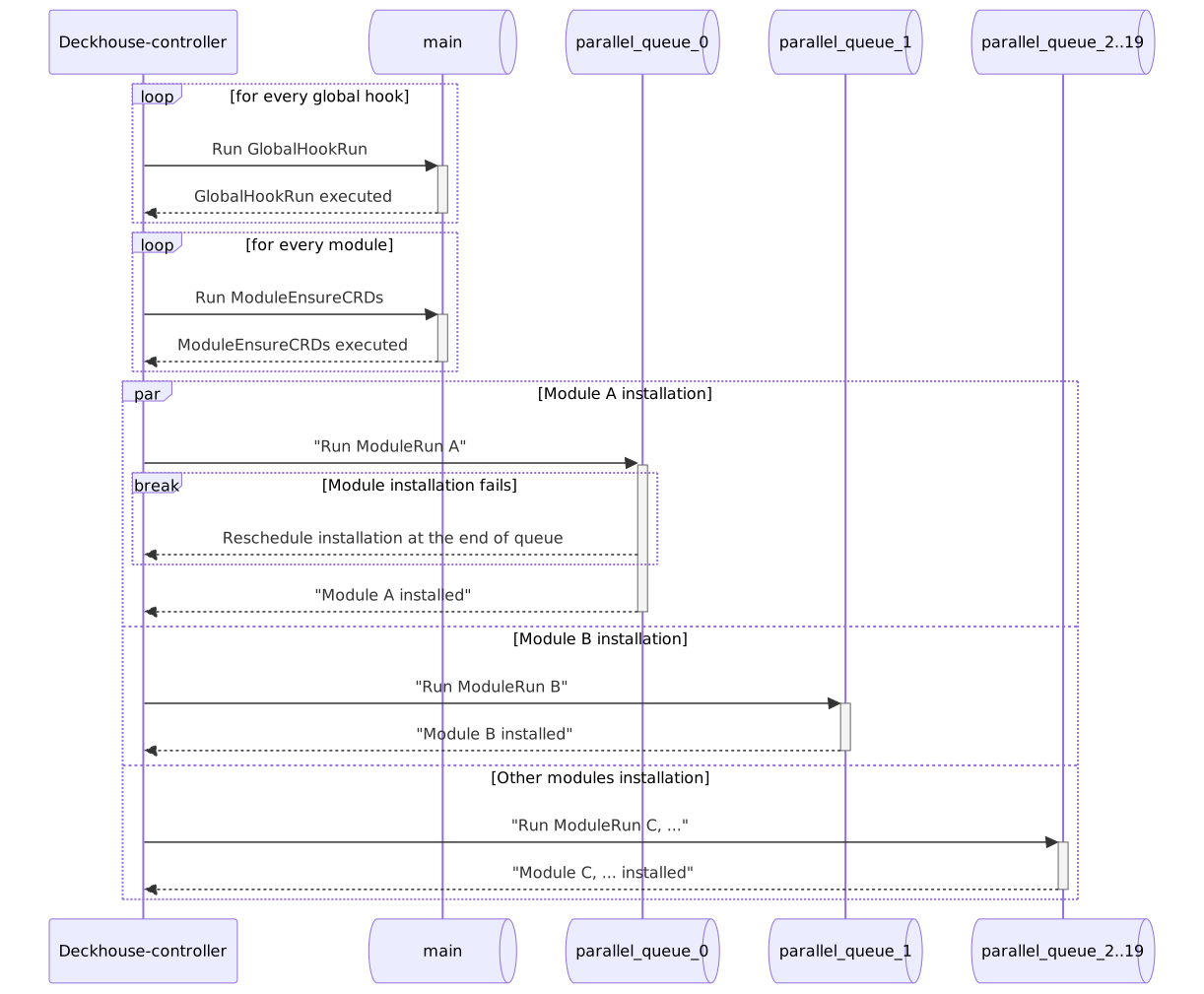
mainqueue. - For non-critical modules, module weight is not considered and tasks are put into
parallel_queue_0..19. - For all modules, dependencies on other modules are considered.
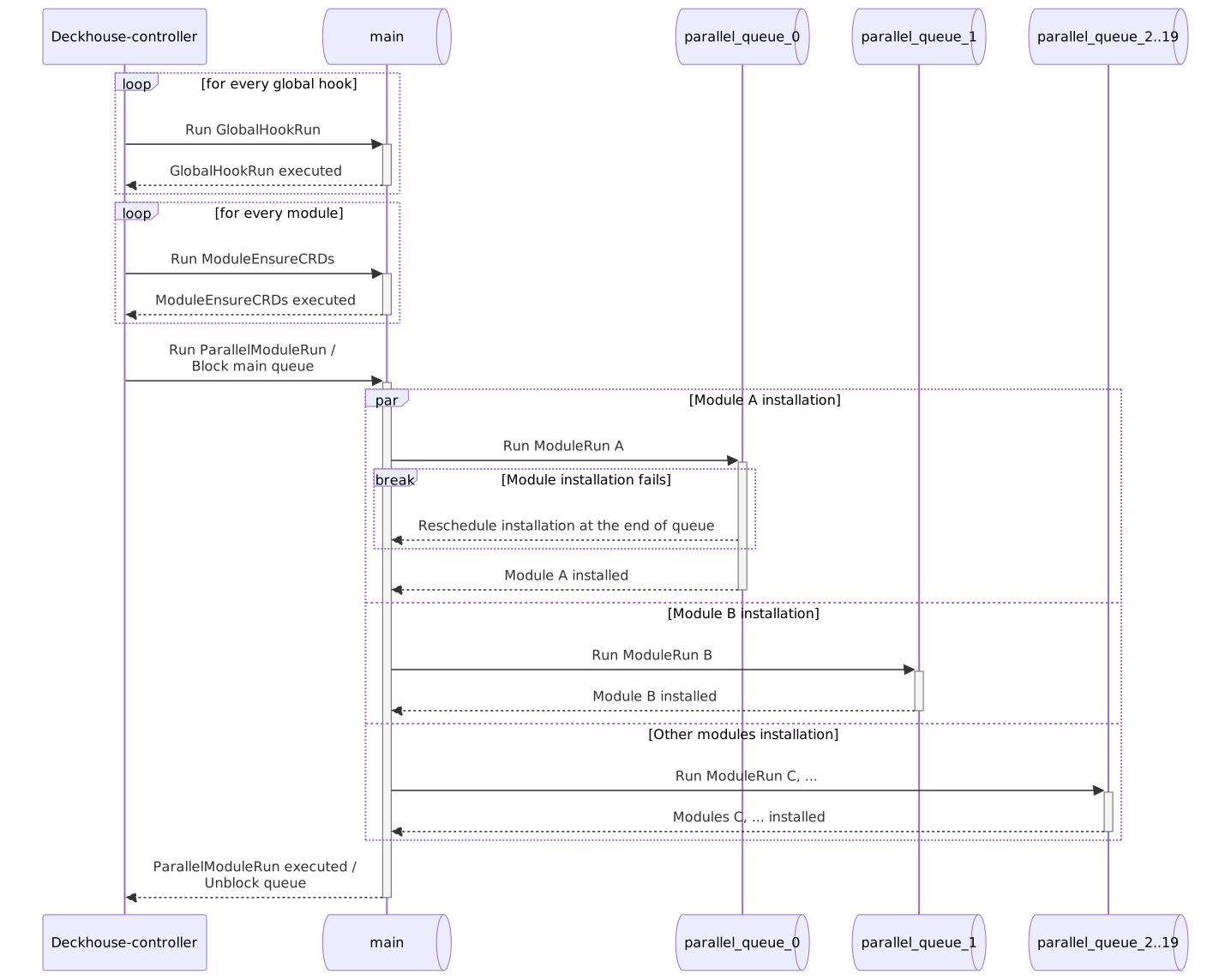
If critical modules can be processed in parallel, the Deckhouse controller scheduler places the ParallelModuleRun task into the main queue with the list of modules. The ParallelModuleRun task starts a ModuleRun task for each module in parallel_queue_0..19 and waits for completion, thereby blocking the main queue. If an error occurs while processing a ModuleRun task, the scheduler moves this task to the end of the queue and starts the next queue task.
The process of installing critical modules is shown in the following diagram:
The process of installing non-critical (functional) modules is shown in the following diagram:
If more than one identical task is added to a queue, all duplicates are removed when such a task starts, as part of deduplication.
To view addon-operator queues, use the d8 system queue list command.
Marketplace queues
The Marketplace queues are a queue implementation used by Marketplace functionality.
Each queue served by the Deckhouse controller for Marketplace has the following properties:
- FIFO (First In First Out): Defines strict task execution order. The first task in queue is executed first.
- Strict sequential execution of tasks, one task at a time.
- Tasks are started only on events (event-driven), without polling any resources.
- Restart on errors with exponential backoff between retries, starting at 15 seconds and capped at 1 minute, with no limit on retry attempts.
- Supports cascading task cancellation on version changes or package deletion.
Queue types:
| Name | Purpose |
|---|---|
{packageName} |
Lifecycle: Deploy, Load, Configure, Enable, Run, Disable, Undeploy |
{packageName}/{hookQueue} |
Running hooks triggered by Kubernetes or schedule events (queue from hook binding) |
{packageName}/{hookQueue}/sync |
Hook synchronization at startup (WaitForSynchronization) |
Task types:
| Task | Function |
|---|---|
| Deploy | Downloads or mounts the package image |
| Load | Parses configuration, creates Application or Module, registers in scheduler |
| Configure | Applies Application or Module settings using the parameter store |
| Enable | Enables hooks, performs parameter synchronization, runs OnStartup hook |
| Run | Runs subtasks when installing Application or Module: BeforeHelm -> helm Upgrade -> AfterHelm |
| HookRun | Runs a hook on event |
| HookSync | Performs initial synchronization of Kubernetes binding |
| Disable | Removes Helm, disables hooks, clears hook queues |
| Undeploy | Removes the package from disk |
Task execution in one queue does not block task execution in another queue.
To view Marketplace queues, run the following command:
When performing module installation or configuration tasks in addon-operator, the Deckhouse controller pauses Marketplace queue processing.