The virtualization module uses components that implement the following auxiliary functions:
- Security events audit.
- Forwarding USB devices to virtual machines (VMs).
- Updating network routes.
- Deleting resources before deactivating the
virtualizationmodule.
Security events audit
For instructions on virtualization module security events audit activation, refer to the module documentation.
Architecture
The following simplifications are made in the diagram:
- The diagram shows containers in different pods interacting directly with each other. In reality, they communicate via the corresponding Kubernetes Services (internal load balancers). Service names are omitted if they are obvious from the diagram context. Otherwise, the Service name is shown above the arrow.
- Pods may run multiple replicas. However, each pod is shown as a single replica in the diagram.
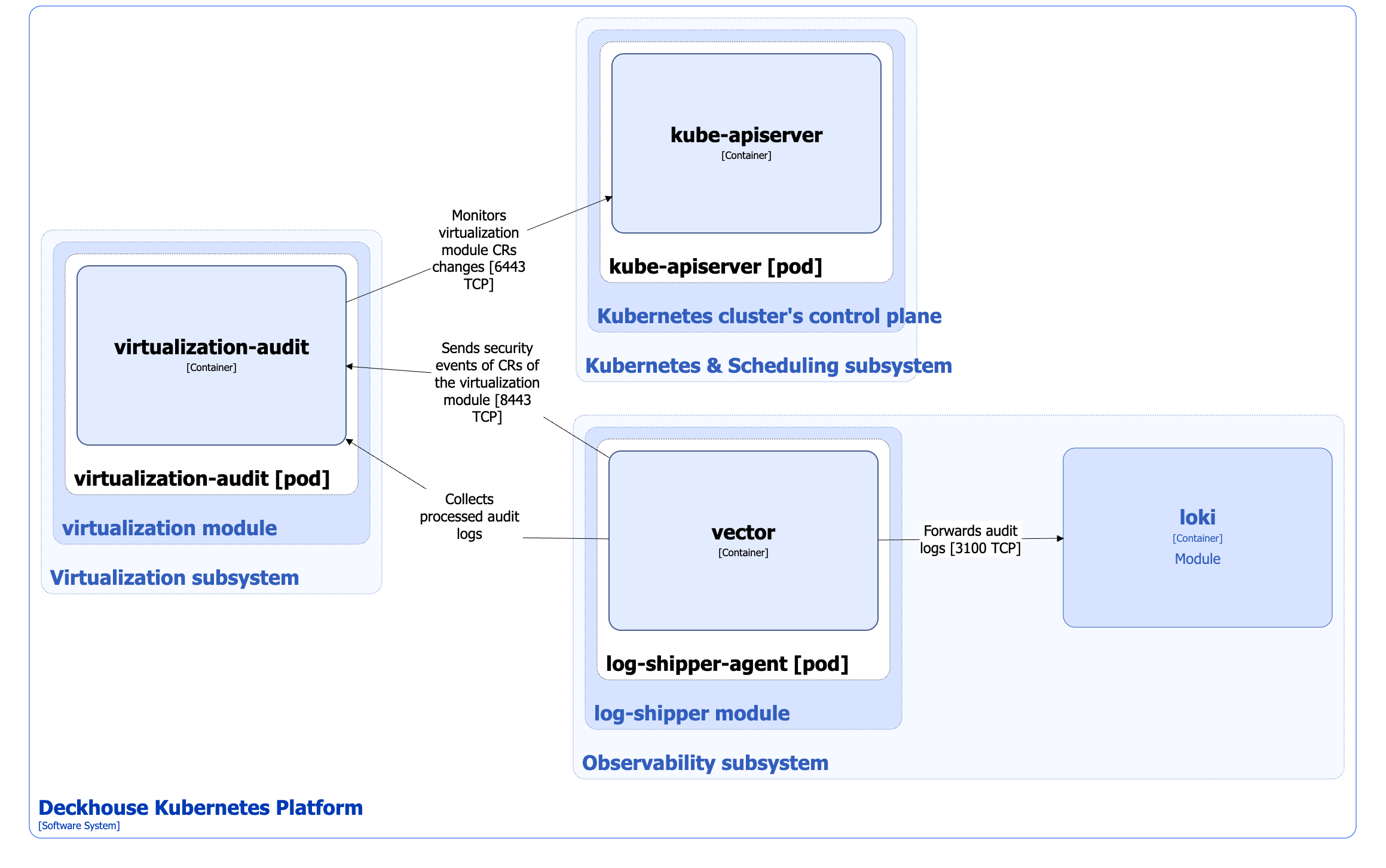
The Level 2 C4 architecture of the virtualization module auxiliary components for security events audit and their interactions with other components of DP is shown in the following diagram:
Components
Virtualization-audit is a component consisting of a single container that receives the virtualization module security events stream.
Sending events is implemented by the log-shipper module. The Vector logging agent, according to the settings in the ClusterLoggingConfig custom resources, selects events related to the virtualization module custom resources from the cluster’s audit log and sends them to the virtualization-audit service endpoint. Virtualization-audit processes the received audit events, enriches them with data from the Kubernetes API, and saves the processed events to its own log.
You can forward security events to the cluster logging system (for example, Loki). In this case, ClusterLoggingConfig resources and the vector agent of the log-shipper module are used in a similar way.
Interactions
Virtualization-audit interacts with the following components:
- Kube-apiserver: Watches for
virtualizationmodule custom resources.
The following external components interact with virtualization-audit:
-
Log-shipper-agent:
- Sends
virtualizationmodule security events. - Collects processed audit logs.
- Sends
Virtualization-dra and other components
Architecture
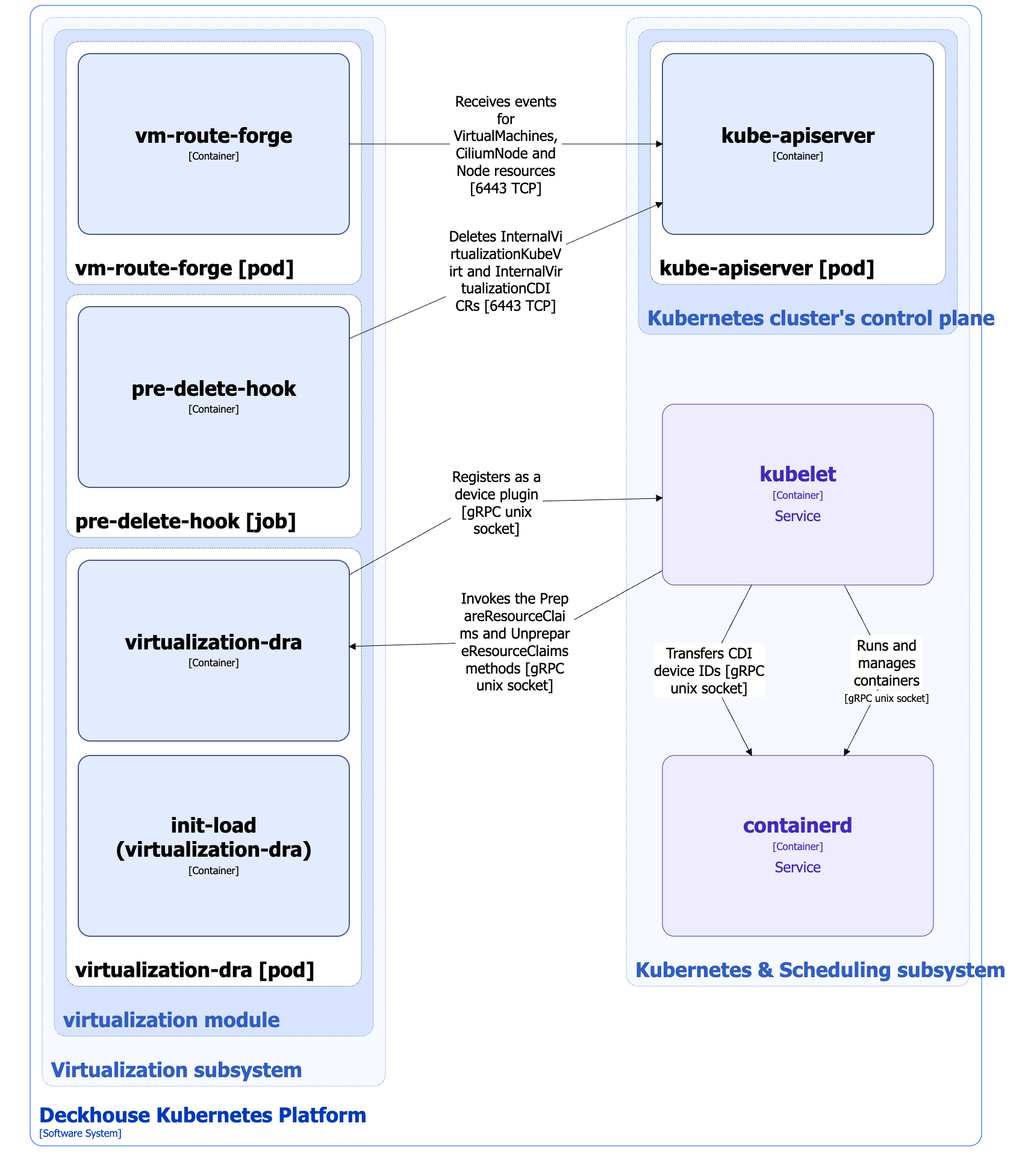
The Level 2 C4 architecture of other virtualization module auxiliary components and their interactions with other components of DP is shown in the following diagram:
Components
-
Virtualization-dra (DaemonSet): The DRA driver that forwards USB devices to VMs. The DRA (Dynamic Resource Allocation) technology is used to forward USB devices. DRA is a Kubernetes API, scheduler, and kubelet engine for describing, scheduling, and provisioning dynamically allocated resources through external drivers. The DRA driver performs the following operations:
-
Automatically detects USB devices on cluster nodes and publishes them as a ResourceSlice resource. virtualization-controller synchronizes this data into NodeUSBDevice custom resources, which are then used to configure USB device forwarding. For more information about configuring USB device forwarding, refer to the module documentation.
-
Registers in kubelet as the DRA kubelet plugin. The DRA kubelet plugin prepares and releases allocated resources for pods through the PrepareResourceClaims and UnprepareResourceClaims operations. The PrepareResourceClaims method returns CDI (Container Device Interface) device IDs that kubelet passes to containerd. Data on available USB devices is published via ResourceSlice, and device selection is performed by the Kubernetes DRA mechanism based on ResourceClaim/ResourceClaimTemplate and DeviceClass.
The DRA driver interacts with kubelet via the gRPC protocol and Unix sockets.
-
Implements a USBIP server, so that the USB device is automatically forwarded over the network to the node where the VM is running. There is no need to manually place the VM on the same node where the device is located.
It consists of the following containers:
- init-load: Init container that loads the Linux kernel modules necessary for the DRA driver operation.
- virtualization-dra: Main container.
-
-
Vm-route-forge: A controller that monitors VirtualMachine custom resources of the
virtualization.deckhouse.ioAPI group and updates network routes on the node via Linux netlink/eBPF in routing tables used by CNI Cilium for routing traffic between VMs. -
Pre-delete-hook (Job): A Job started by the Deckhouse controller before the
virtualizationmodule is deleted. It removes the InternalVirtualizationKubeVirt and InternalVirtualizationCDI custom resources namedconfig.
Interactions
Virtualization-dra interacts with the following components:
- Kubelet: Registers in kubelet as the DRA kubelet plugin.
Vm-route-forge interacts with the following components:
- Kube-apiserver: Receives events on VirtualMachine, CiliumNode and Node resources.
- Host network/Linux kernel: Updates routes and routing rules on the node.
- Cilium data plane: Uses data from the CiliumNode and Cilium routing tables to route VM traffic.
Pre-delete-hook interacts with the following components:
- Kube-apiserver: Deletes InternalVirtualizationKubeVirt and InternalVirtualizationCDI resources named
config.
The following external components interact with Virtualization-dra:
- Kubelet: Calls PrepareResourceClaims and UnprepareResourceClaims gRPC methods to prepare and release resources associated with USB devices.