The security-events-manager module within Deckhouse Platform (DP) performs declarative collection, processing,
normalization, and delivery of security events extracted from logs of applications
and Kubernetes infrastructure components.
A security event is a structured record of an action or fact that is significant from an information security perspective. Typical categories of such events include:
- Authentication and authorization
- Access to APIs and configuration
- Changes to cluster objects
- Runtime and network activity anomalies
Regardless of the original log format, the output is a uniform event model with a mandatory minimum set of attributes.
The security-events-manager module is in the Experimental stage and may change in future releases.
Solution architecture
The architecture is intended to build a unified pipeline for working with security events extracted from the logs of applications and Kubernetes infrastructure components. The module performs three processing stages:
- Collection: Collecting logs from pod sources and node files, initial selection of records that may contain security events.
- Processing and enrichment: Parsing logs, extracting event signals, transforming into a unified model, and enriching with context.
- Delivery: Policy-based filtering and delivery to configured storages.
At the delivery stage, sending to several types of storage and analytics systems is supported (such as Loki, Elasticsearch, Kafka, Splunk, Vector, File).
Processing pipeline
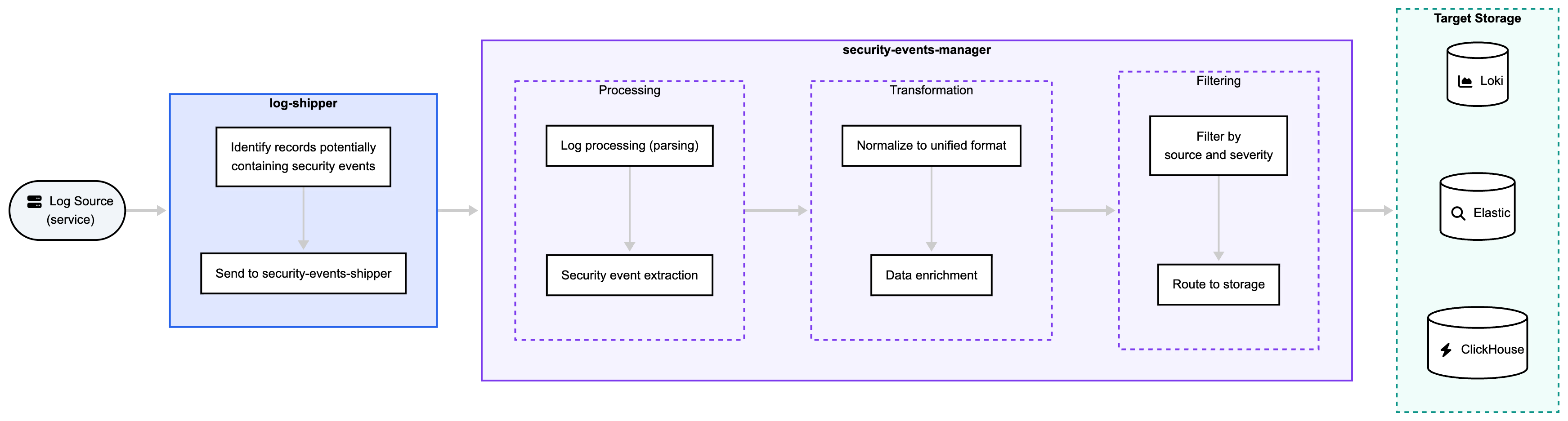
The architecture separates three stages of the pipeline: collection, processing and enrichment, and delivery.
Collection layer (log-shipper)
Collection is performed via the auxiliary log-shipper module:
- Container sources use application logs within the namespace.
- Cluster sources use node files and system service logs (for example,
/var/log/kube-audit/audit.log,/var/log/auth.log).
A two-tier scheme is used:
- The
log-shippermodule performs preliminary selection of log records using simple comparison operators (In,NotIn,Regex,NotRegex,Exists,DoesNotExist) and forwards them to the gateway. - The
security-events-managermodule (gateway) performs field recognition (parsing), further processing, and delivery.
Because log parsing is resource-intensive, it is performed only for records pre-selected as potentially containing security events, not for all incoming logs. Therefore, the initial selection stage does not perform deep field-value filtering that requires full content parsing.
Example of an input log for the selection stage:
{
  "time": "2026-05-10T14:21:03Z",
  "kind": "Event",
  "source": "kube-apiserver",
  "level": "Metadata",
  "message": "Unauthorized",
  "reason": "Unauthorized",
  "code": 401,
  "requestURI": "/api/v1/namespaces/default/secrets",
  "user": "system:serviceaccount:default:demo",
  "sourceIPs": [
    "206.123.145.70"
  ]
}
Processing and extraction
After being forwarded to the gateway, the log structure is recognized. Standard processing strategies are supported:
JSON: For structured logs.Regex: For string formats with predictable patterns.Grok: For complex, non-unified formats.
The processing result is used to derive event signals and build a unified set of fields.
Example output of the processing stage:
{
  "parsed": {
    "timestamp": "2026-05-10T14:21:03Z",
    "source_component": "kube-apiserver",
    "http_status": 401,
    "request_uri": "/api/v1/namespaces/default/secrets",
    "actor_id": "system:serviceaccount:default:demo",
    "source_ip": "206.123.145.70"
  }
}
After processing, the record becomes a source of fields for event classification
(code/category/severity/outcome), as well as for building context
(actor, network attributes, and source metadata).
Transformation and enrichment
Transformation is implemented in two steps:
- Transform: Mapping fields from the original log to the fields of the target event model.
- Enrich: Adding or refining fields from additional context sources (for example, static environment attributes, subject roles, and service indicators).
The order is fixed: Transform is applied first, then Enrich.
In case of a conflict for a target field, the final value is determined by the Enrich stage.
Filtering and delivery
After the event is formed, a delivery policy is applied:
- Source filtering
- Filtering by minimum severity
- Routing to one or more destinations
Filtering rules can use both exact source identifiers and source masks, which makes it possible to manage flows at the level of individual services or entire groups.
Destinations can be storage and processing systems such as cluster Loki, external SIEM/log platforms, and streaming buses. The delivery scheme supports parallel delivery to multiple target systems.
Security event model
Below is the structure of the event that is sent to storage.
Required fields:
id,timestampsource.componentevent.code,event.category,event.severity,event.outcomeeventMetadata.cluster
Optional fields:
eventMetadata.sourceIPsactor.*object.*
{
  "id": "2f0de5c2-2e58-4d3f-b4fe-5ec6f1935b9f",
  "timestamp": "2026-05-10T14:21:03Z",
  "source": {
    "component": "kube-apiserver"
  },
  "event": {
    "code": "UNAUTHORIZED_ACCESS",
    "category": "Rbac",
    "severity": "High",
    "outcome": "Failure"
  },
  "eventMetadata": {
    "cluster": "prod-cluster",
    "sourceIPs": [
      "206.123.145.70"
    ]
  },
  "actor": {
    "id": "system:serviceaccount:default:demo",
    "type": "ServiceAccount"
  },
  "object": {
    "id": "/api/v1/namespaces/default/secrets",
    "type": "KubernetesResource"
  }
}
Minimal sufficient lifecycle
In a practical scenario, the architecture works along the following chain:
- Log sources are connected to the collection pipeline.
- An initial selection of potentially relevant records is performed.
- Records are processed and transformed into unified events.
- Events are enriched with contextual attributes.
- Filtering and routing rules are applied.
- Events are delivered to target storages and analytics systems.
The result is a unified and manageable flow of security events suitable for monitoring, investigations, and long-term auditing.
Supported security events
The security-events-manager module ships with a built-in set of security event detection rules
covering authentication, configuration, RBAC, runtime, and other categories.
For the up-to-date list of implemented security events, their codes, severity levels, and descriptions,
refer to the module documentation.