The user-authz module implements role-based access control (RBAC) in Deckhouse Platform (DP). The module creates cluster roles for managing user and group access to cluster resources, and, in the Ultimate, CSE Core, and CSE Pro editions of DP, also supports namespace-scoped authorization (multitenancy).
For more details about the role-based access control model, refer to the corresponding section of the module documentation.
The module works with the following custom resources of the deckhouse.io API group:
- ClusterAuthorizationRule: Defines access rules at the cluster level.
- AuthorizationRule: Defines access rules within a single namespace.
In the Ultimate, CSE Core, and CSE Pro editions of DP, the module additionally works with the following custom resources of the authorization.deckhouse.io API group:
- BulkSubjectAccessReview: A resource for bulk-checking user permissions across multiple objects or actions.
- AccessibleNamespace: A resource for retrieving the list of namespaces accessible to a specific user.
- WhoCan: A resource for finding which users, groups, and service accounts are allowed to perform a given action.
- SubjectAccessReport: A resource for retrieving the full list of permissions granted to a subject.
- RoleAccessReport: A resource for retrieving the full list of resources and actions granted by a role.
For more details about module configuration and usage examples, refer to the corresponding documentation section.
Module architecture
The following assumptions are made to simplify the diagram:
- The diagram shows direct interaction between containers from different pods. In practice, they communicate through corresponding Kubernetes Services (internal load balancers). Service names are omitted when they are clear from context. In other cases, the service name is shown above the arrow.
- Pods can run with multiple replicas, but all pods are shown as a single replica in the diagram.
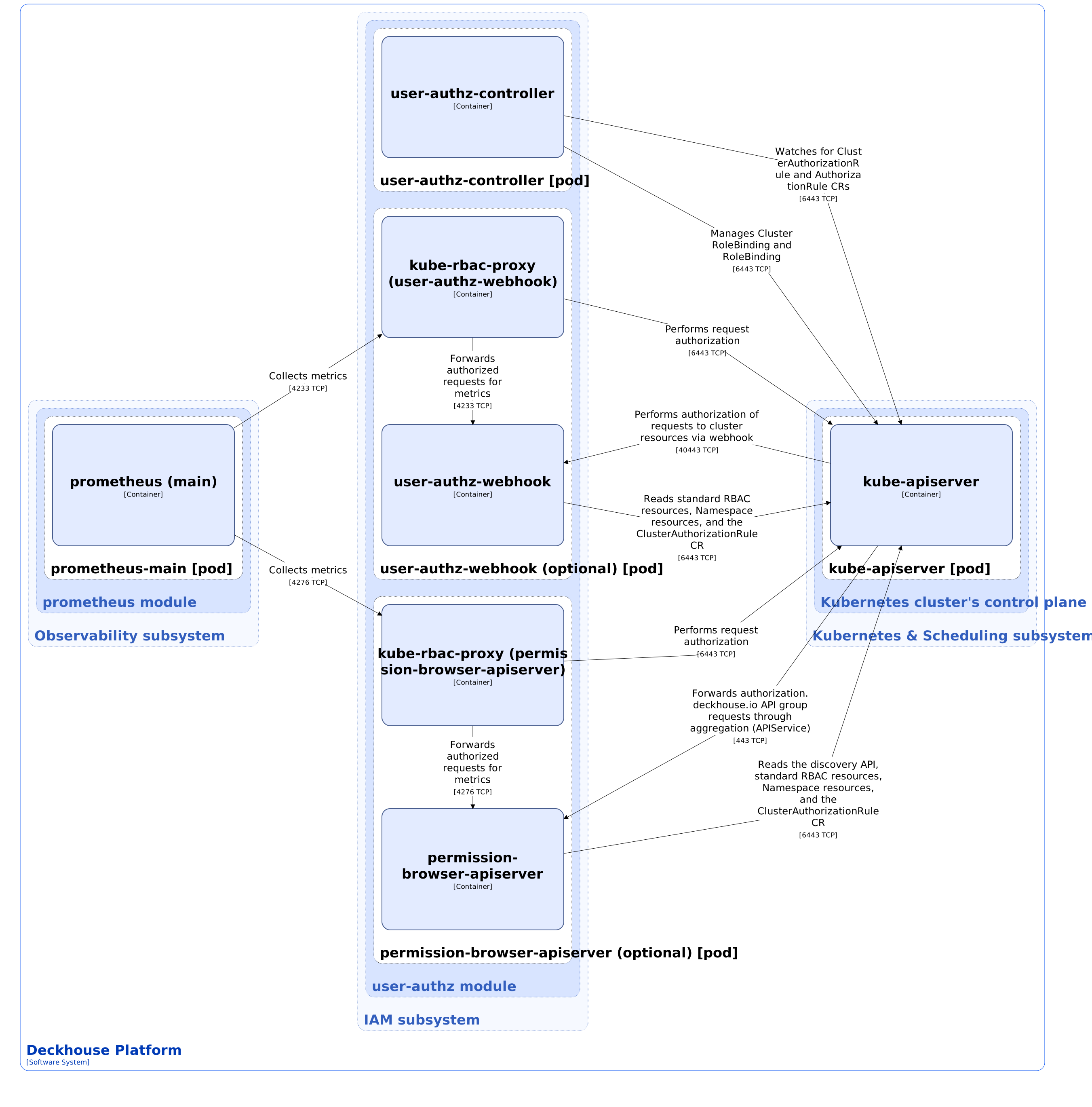
The level 2 C4 architecture of the user-authz module and its interactions with other DP components are shown in the following diagram:
Module components
The module consists of the following components:
- User-authz-controller (Deployment): This component includes a single user-authz-controller container and watches the ClusterAuthorizationRule and AuthorizationRule custom resources, creating, updating, and deleting the corresponding ClusterRoleBinding and RoleBinding resources.
The Ultimate, CSE Core, and CSE Pro editions of DP additionally include the following components:
-
User-authz-webhook (DaemonSet): An optional component that implements the Webhook authorization mode for kube-apiserver, placed between the built-in Node and RBAC authorizers in the authorization chain. The component runs on all master nodes with
hostNetworkenabled.The webhook authorization mode for kube-apiserver is configured by the
control-plane-managermodule if the.controlPlaneConfigurator.enabledparameter in the module settings is set totrue(the default). As part of this, thecontrol-plane-managermodule creates an AuthorizationConfiguration whosematchConditionsparameter excludes the following subjects from being checked by the webhook:- Core control plane system identities, such as
kubernetes-admin. - Node identities,
system:node:*. - Service accounts from the
kube-systemandd8-*namespaces.
Upon receiving a
SubjectAccessReviewrequest, the webhook checks the namespace access restrictions defined in the ClusterAuthorizationRule custom resource (multitenancy). It does not restrict a subject that has RBAC access regardless of the ClusterAuthorizationRule restrictions. This allows both access models to work together.The component can only deny a request explicitly; for every other request it returns no opinion, and the decision falls through to the RBAC authorizer. User-authz-webhook is fail-closed, so if the webhook is unavailable or does not respond in time, kube-apiserver denies every non-excluded request instead of falling back to RBAC.
The following fail-closed parameters are used for the webhook:
failurePolicyis set toDeny.- Timeout: 3 seconds.
- Decisions are cached separately for authorized and unauthorized requests (
authorizedTTL: 5m/unauthorizedTTL: 30s).
The Deckhouse controller deploys this component if the
.enableMultiTenancyparameter in the module settings is set totrue(default isfalse).Includes the following containers:
- user-authz-webhook: Main container.
- kube-rbac-proxy: Sidecar container with an authorization proxy based on Kubernetes RBAC that provides secure access to component metrics.
- Core control plane system identities, such as
-
Permission-browser-apiserver (Deployment): An optional component, a Kubernetes API extension that publishes custom resources of the
authorization.deckhouse.ioAPI group.The BulkSubjectAccessReview, AccessibleNamespace, WhoCan, SubjectAccessReport, and RoleAccessReport custom resources of the
authorization.deckhouse.ioAPI group are used by theconsolemodule and provide extended capabilities for determining user, resource, or action permissions.The Deckhouse controller deploys this component if the
.enableMultiTenancyparameter in the module settings is set totrue(default isfalse).To expand wildcard RBAC rules into the cluster’s actual API resources and determine whether each one is namespaced or cluster-scoped, it periodically queries the Kubernetes Discovery API endpoint and caches the result.
Includes the following containers:
- permission-browser-apiserver: Main container.
- kube-rbac-proxy: Sidecar container with an authorization proxy based on Kubernetes RBAC that provides secure access to component metrics.
Module interactions
The module interacts with the following components:
-
Kube-apiserver:
- Watches the ClusterAuthorizationRule and AuthorizationRule custom resources.
- Manages the ClusterRoleBinding and RoleBinding resources.
- Reads Namespace and RBAC resources, and queries the discovery API.
- Authorizes requests for metrics.
The following external components interact with the module:
-
Kube-apiserver:
- Authorizes requests to cluster resources.
- Forwards requests to the
authorization.deckhouse.ioAPI group.
-
Prometheus-main: Collects metrics from the user-authz-webhook and permission-browser-apiserver components.