The commander and commander-agent modules are used to implement cluster management in Deckhouse Platform (DP).
A DP cluster with the commander module installed is a managing cluster.
A DP cluster with the commander-agent module installed is a managed cluster.
Сommander module
The commander module implements a web application that allows you to create standardized DP clusters and manage their configurations and lifecycle.
To install the commander module, you need a PostgreSQL instance. It can be deployed inside or outside the cluster by using the managed-postgresql module.
For commander in production environments, using a dedicated PostgreSQL instance is recommended.
When commander is installed, a PostgreSQL data encryption key is generated. This key is stored in the d8-commander namespace in the commander-envs Secret.
For details about features, configuration, and usage examples, see the module documentation section.
Сommander module architecture
The following simplifications are made in the diagram:
- The diagram shows containers in different pods interacting directly with each other. In reality, they communicate via the corresponding Kubernetes Services (internal load balancers). Service names are omitted if they are obvious from the context. Otherwise, the Service name is shown above the arrow.
- Pods may run multiple replicas. However, each pod is shown as a single replica in the diagram.
- The diagram shows only the main containers of each component.
The Level 2 C4 architecture of the commander module
and its interaction with other DP components are shown in the following
diagram:
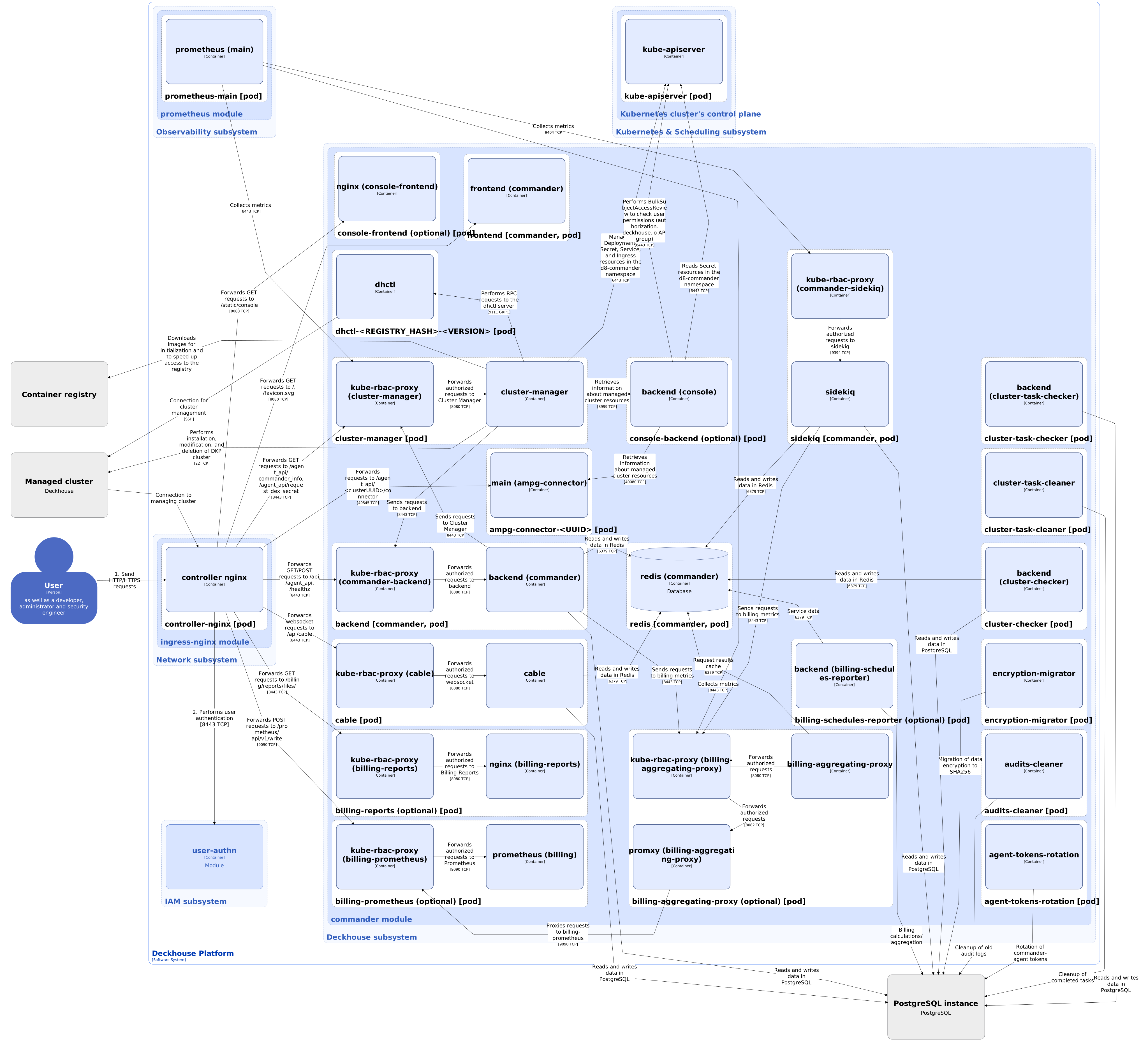
Сommander module components
The module consists of core, service, and optional components.
Core components
Core components of the commander module include:
-
Frontend (Deployment): Provides a web interface for cluster management.
Contains the following containers:
- wait-postgres: An init container that checks PostgreSQL instance availability.
- wait-migrations: An init container that waits for all database migrations to complete.
- frontend: The main container.
-
Backend (Deployment): The main component that implements the following APIs:
- UI API: Manages cluster, template, and workspace settings.
- External API for integrations and automation: Operates on clusters, tasks, templates, projects, roles, and more.
- API for cluster-manager: Exchanges cluster task states and processes deployment and configuration phases of managed clusters.
- API for
commander-agent: Authorizes and receives agent metrics, and provides target configuration for a managed cluster.
Backend provides the following capabilities:
- Cluster lifecycle management: Creates, modifies, or deletes a cluster (through cluster-manager), restarts failed tasks, and runs related checks.
- Cluster RBAC management and API operation access restrictions.
- Template management and storage of target and current cluster settings.
- Container registry management.
- Project and project template management.
- Billing settings management (if this component is enabled).
The component stores the target system state in a PostgreSQL instance. It also uses a Redis instance to publish tasks to managed clusters and receive task processing results.
Contains the following containers:
- wait-postgres: An init container that checks PostgreSQL instance availability.
- wait-migrations: An init container that waits for all database migrations to complete.
- backend: The main container.
- kube-rbac-proxy: A sidecar container with a Kubernetes RBAC-based authorization proxy that provides secure access to the main container.
-
Cable (Deployment): Provides WebSocket support for real-time UI updates.
Contains the following containers:
- wait-postgres: An init container that checks PostgreSQL instance availability.
- wait-migrations: An init container that waits for all database migrations to complete.
- cable: The main container.
- kube-rbac-proxy: A sidecar container with a Kubernetes RBAC-based authorization proxy that provides secure access to the main container.
-
Sidekiq (Deployment): A component based on the Sidekiq library that provides queue processing in Ruby on Rails.
Contains the following containers:
- wait-postgres: An init container that checks PostgreSQL instance availability.
- wait-migrations: An init container that waits for all database migrations to complete.
- sidekiq: The main container.
- kube-rbac-proxy: A sidecar container with a Kubernetes RBAC-based authorization proxy that provides secure access to the main container.
-
Cluster-manager (Deployment): Executes tasks requested by backend to deploy managed DP clusters and manage their configuration.
When a new cluster is created, cluster-manager creates the following resources in the
d8-commandernamespace of the managing cluster:- Deployment and Secret named
dhctl-<REGISTRY_HASH>-<VERSION>: Runs dhctl in gRPC server mode. Cluster-manager uses RPC calls to install and configure a DP cluster. - To process incoming
commander-agentconnections and implement a reverse interaction channel with the control plane of the corresponding cluster:- Deployment (
ampg-connector-<UUID>) - Service:
ampg-connector-<UUID>ampg-console-backend-<UUID>ampg-api-server-<UUID>ampg-deckhouse-tools-<UUID>ampg-aggregating-proxy-<UUID>ampg-upmeter-<UUID>ampg-label-proxy-<UUID>
- Secret (
ampg-console-backend-<UUID>) - Ingress (
ampg-agent-api-connector-<UUID>,ampg-console-backend-<UUID>)
- Deployment (
- DexClient (
cluster-<UUID>): Configures the authentication service for a managed cluster using the capabilities of theuser-authnmodule.
During cluster bootstrap, cluster-manager also performs the following actions in the managed cluster:
- Installs the
commander-agentmodule. - Disables the
terraform-managermodule. - Configures authentication based on the Dex controller of the
user-authnmodule. As a Dex provider, cluster-manager setscluster-<UUID>DexClient from the managing cluster. - Configures the managed cluster connection to a container registry.
- If billing is enabled, creates a PrometheusRemoteWrite custom resource to send metrics to the billing-prometheus component in the managing cluster.
Contains the following containers:
- wait-postgres: An init container that checks PostgreSQL instance availability.
- wait-migrations: An init container that waits for all database migrations to complete.
- cluster-manager: The main container.
- kube-rbac-proxy: A sidecar container with a Kubernetes RBAC-based authorization proxy that provides secure access to the main container.
- Deployment and Secret named
-
Dhctl-<REGISTRY_HASH>-<VERSION> (Deployment): A component with a single dhctl container. It runs the dhctl utility in gRPC server mode. Cluster-manager uses RPC calls to the
dhctlserver to install or configure a managed DP cluster. -
Ampg-connector-<UUID> (Deployment): A component with a single main container that establishes a tunnel and proxies requests to the control plane of a managed DP cluster through the incoming
commander-agentconnection.The component is created by cluster-manager for each managed DP cluster.
-
Cluster-checker (Deployment): Periodically starts cluster verification tasks.
Contains the following containers:
- wait-postgres: An init container that checks PostgreSQL instance availability.
- wait-migrations: An init container that waits for all database migrations to complete.
- backend: The main container.
-
Cluster-task-checker (Deployment): Periodically searches for running tasks that have not reported their status for a long time and moves them to
lostorlost_in_critical.Contains the following containers:
- wait-postgres: An init container that checks PostgreSQL instance availability.
- wait-migrations: An init container that waits for all database migrations to complete.
- backend: The main container.
-
Redis (Deployment): A component with a single redis container that provides a dedicated Redis database instance for storing task queue data and commander session states.
-
Console-frontend (Deployment): Provides the managed DP cluster administration web interface.
Contains the following containers:
- wait-postgres: An init container that checks PostgreSQL instance availability.
- wait-migrations: An init container that waits for all database migrations to complete.
- nginx: The main container.
-
Console-backend (Deployment): An administration API backend for the managed DP cluster that serves requests from the cluster-manager component.
Console-backend uses Secret and Service resources created by cluster-manager to connect to the control plane of a managed DP cluster.
Contains the following containers:
- wait-postgres: An init container that checks PostgreSQL instance availability.
- wait-migrations: An init container that waits for all database migrations to complete.
- backend: The main container.
Service components
Service components of the commander module include:
-
Cluster-task-cleaner (CronJob): Runs once a day and removes completed tasks created more than 30 days ago.
Contains the following containers:
- wait-postgres: An init container that checks PostgreSQL instance availability.
- wait-migrations: An init container that waits for all database migrations to complete.
- cluster-task-cleaner: The main container.
-
Agent-tokens-rotation (CronJob): Regularly rotates
commander-agenttokens.Contains the following containers:
- wait-postgres: An init container that checks PostgreSQL instance availability.
- wait-migrations: An init container that waits for all database migrations to complete.
- agent-tokens-rotation: The main container.
-
Encryption-migrator (CronJob): Runs once a day and migrates encrypted data from SHA-1 to SHA-256. Not all data may be processed in a single run. In addition, after restoring from backup or due to delayed migrations, SHA-1 records may appear.
Contains the following containers:
- wait-postgres: An init container that checks PostgreSQL instance availability.
- wait-migrations: An init container that waits for all database migrations to complete.
- encryption-migrator: The main container.
-
Audits-cleaner (CronJob): Runs once a day and deletes old audit logs.
The Deckhouse controller of the
deckhousemodule creates audits-cleaner if thesettings.featureFlags.auditsRetentionDaysmodule parameter is set and defines the audit log retention period.Contains the following containers:
- wait-postgres: An init container that checks PostgreSQL instance availability.
- wait-migrations: An init container that waits for all database migrations to complete.
- audits-cleaner: The main container.
Optional components
Optional components of the commander module include:
-
Billing-prometheus (StatefulSet): Runs Deckhouse Prom++ in metrics ingestion mode over the Prometheus Remote Write protocol.
The
prometheusmodule in a managed DP cluster sends metrics. The component stores resource usage history for all managed clusters, which is an important data source for billing reports.Contains the following containers:
- prometheus: The main container.
- kube-rbac-proxy: A sidecar container with a Kubernetes RBAC-based authorization proxy that provides secure access to the main container.
-
Billing-reports (StatefulSet): A component that runs the nginx web server as billing report storage. Reports are uploaded to nginx over Web-based Distributed Authoring and Versioning (WebDAV).
Contains the following containers:
- nginx: The main container.
- kube-rbac-proxy: A sidecar container with a Kubernetes RBAC-based authorization proxy that provides secure access to the main container.
-
Billing-schedules-reporter (Deployment): Implements a scheduler that starts and controls tasks for generating required billing reports.
The billing-schedules-reporter component saves generated reports to billing-reports over WebDAV.
Contains the following containers:
- wait-postgres: An init container that checks PostgreSQL instance availability.
- wait-migrations: An init container that waits for all database migrations to complete.
- backend: The main container.
-
Billing-aggregating-proxy (Deployment): Aggregates PromQL queries, proxies them to billing-prometheus, and returns query results.
Contains the following containers:
- billing-aggregating-proxy: A sidecar container based on Grafana Mimir. It provides query optimization and data caching. If data is missing in the cache, Grafana Mimir forwards the request to billing-prometheus via the promxy sidecar container.
- promxy: A sidecar container based on Promxy. It proxies requests to billing-prometheus and provides a single endpoint for accessing data from multiple Deckhouse Prom++ instances.
- kube-rbac-proxy: A sidecar container with a Kubernetes RBAC-based authorization proxy that provides secure access to the main container.
The billing-prometheus, billing-reports, billing-schedules-reporter, and billing-aggregating-proxy components are created by the Deckhouse controller of the deckhouse module if settings.featureFlags.billingEnabled is set to true.
Module interactions
The module interacts with the following components:
-
Kube-apiserver:
- Works with Deployment, Service, Secret, and Ingress resources in the
d8-commandernamespace. - Authorizes requests.
- Works with Deployment, Service, Secret, and Ingress resources in the
-
Container registry: Retrieves available DP releases by release channels.
-
PostgreSQL instance: Stores cluster states and metadata, tasks, tokens, projects, billing parameters, and reports.
-
Managed cluster: Creates, modifies, or deletes DP clusters.
The following external components interact with the module:
-
Controller-nginx: Forwards external requests to module component endpoints.
-
Prometheus-main: Collects metrics from module components.
Сommander-agent module
The commander-agent module establishes a service connection to a managing DP cluster.
For details about module settings, see the module documentation section.
Сommander-agent module architecture
The Level 2 C4 architecture of the commander-agent module and its interaction with other DP components are shown in the following diagram:
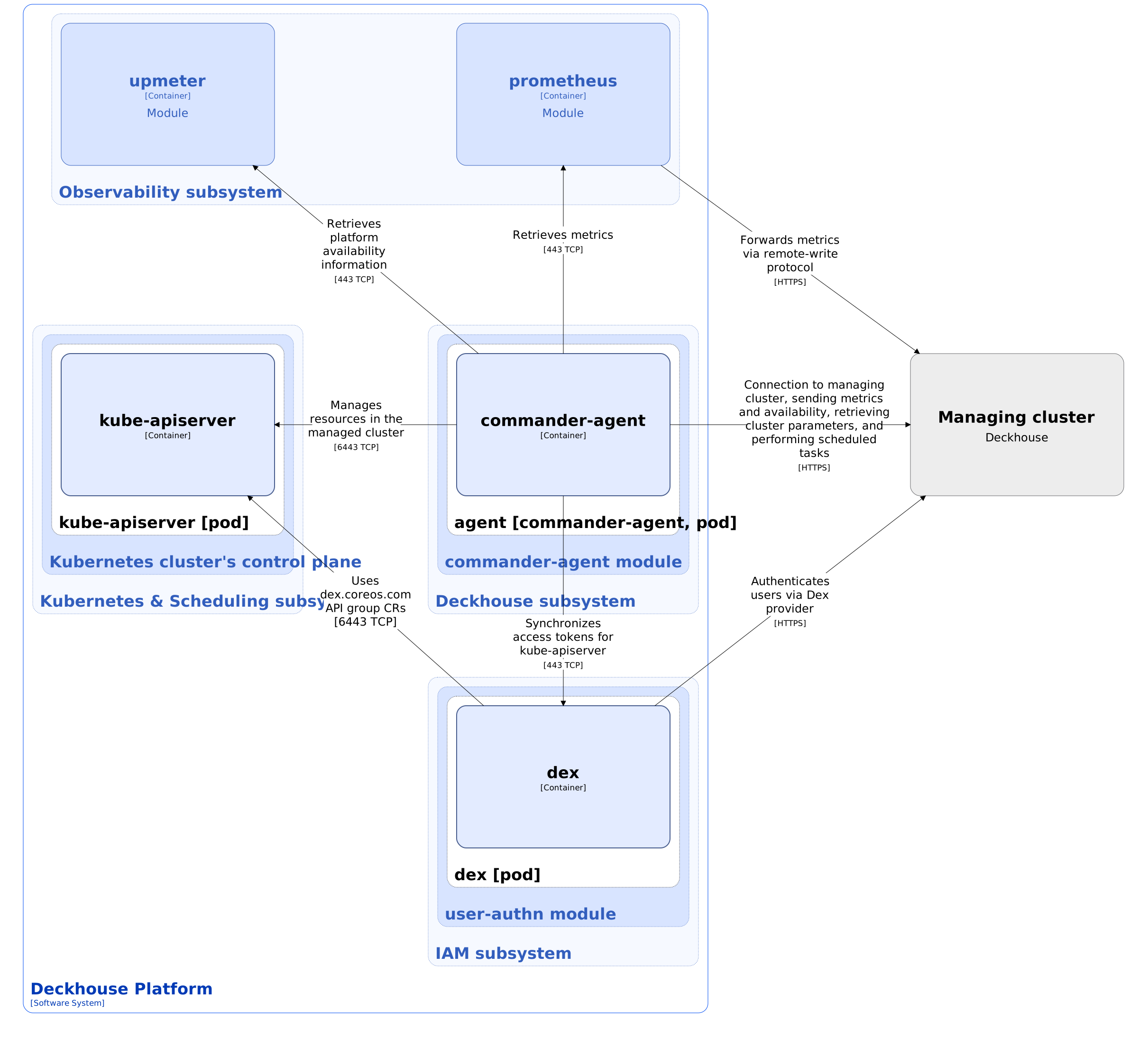
Сommander-agent module components
The module consists of one agent component and one commander-agent container.
Agent performs the following actions:
- Brings managed cluster configuration in line with target configuration received from
commandermodule backend. - Collects managed cluster metrics:
CPU cores: Number of node CPU cores.Memory: Total node memory in GiB.Filesystem: Total size of node root disks in GiB.PVC: Total size of attached disks in GiB.Nodes: Total number of nodes.
- Collects cluster availability information.
- Establishes a secure connection to the managing DP cluster.
- Sends metrics and cluster availability information to the managing DP cluster.
- Configures user authentication via the Dex provider of the managing cluster.
- If billing is enabled in the managing cluster, creates a PrometheusRemoteWrite custom resource to send metrics to the billing service of the managing DP cluster.
Module interactions
The module interacts with the following components:
-
Kube-apiserver: Manages resources of the managed cluster.
-
Prometheus: Retrieves metrics from the managed cluster.
-
Upmeter: Retrieves availability information of the managed cluster.
-
Dex: Synchronizes access tokens for Kubernetes API requests from the managing cluster to the managed cluster.
-
Managing cluster:
- Organizes a proxy connection to the managing cluster.
- Receives target cluster configuration.
- Sends metrics to the billing service.