The alb module implements an application load balancer (ALB, Application Load Balancer) in Deckhouse Platform (DP) and lets you publish applications using the Kubernetes Gateway API. It deploys and configures the infrastructure for accepting and routing external requests, and validates the user’s Gateway API configuration. ALB is based on the Envoy Open Source project.
The module works with the following custom resources of the network.deckhouse.io API group:
- ClusterALBInstance: Defines a cluster-wide ALB (data plane) instance, used for shared or platform-level Gateways.
- ALBInstance: Defines an ALB instance within a user namespace, used for application- or project-level Gateways.
For more details about module configuration and usage examples, refer to the corresponding documentation section.
Module architecture
The following simplifications are made in the diagram:
- The diagram shows containers in different pods interacting directly with each other. In reality, they communicate via the corresponding Kubernetes Services (internal load balancers). Service names are omitted if they are obvious from the diagram context. Otherwise, the Service name is shown above the arrow.
- Pods may run multiple replicas. However, each pod is shown as a single replica in the diagram.
The Level 2 C4 architecture of the alb module and its interactions with other components of DP are shown in the following diagram:
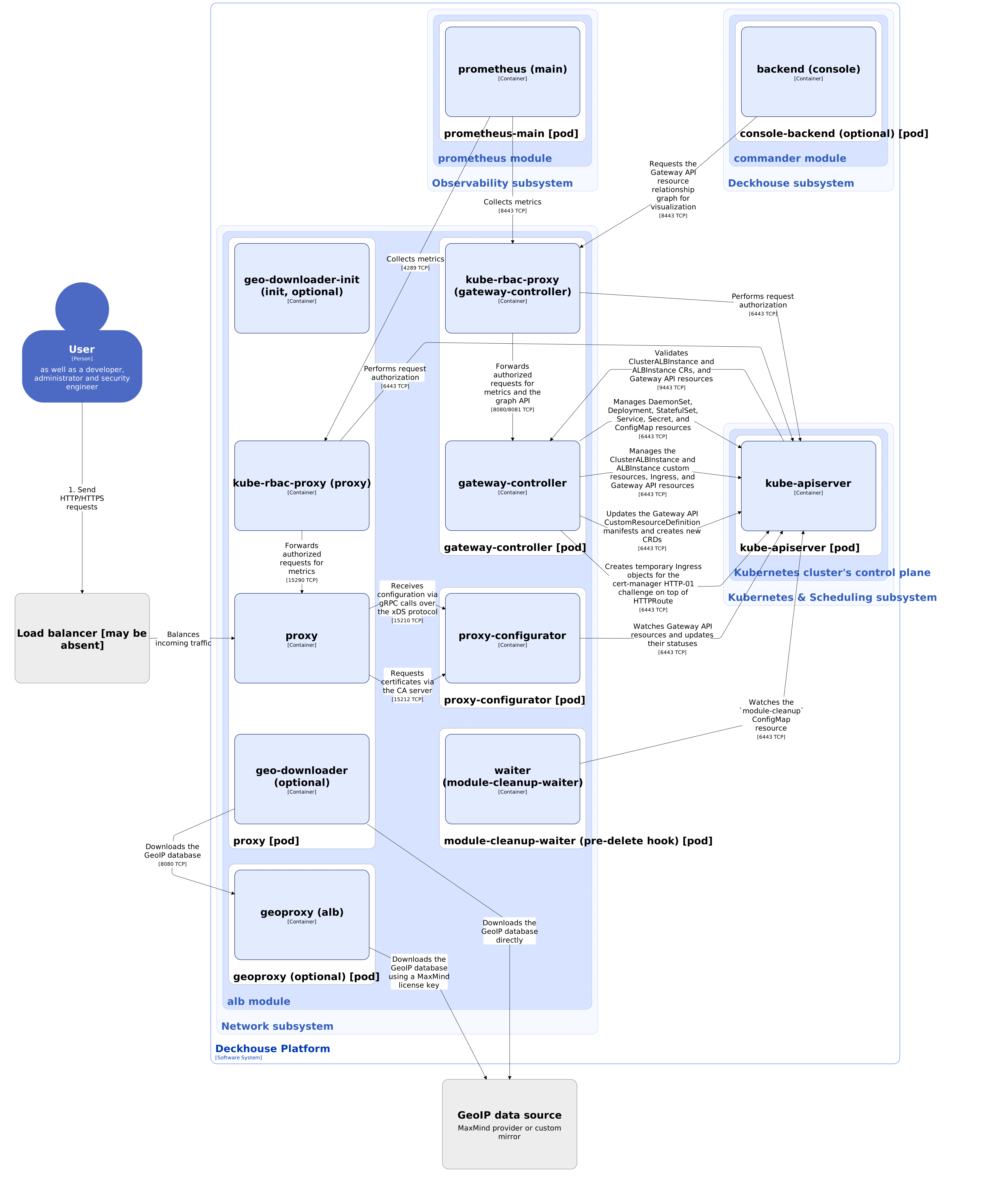
Module components
The module consists of the following components:
-
Gateway-controller (Deployment): the module’s central controller, which performs the following actions:
- Manages the ClusterALBInstance and ALBInstance custom resources.
- Installs Gateway API CRDs (the
gateway.networking.k8s.ioAPI group). - Implements the Gateway API controller for the
d8-albGatewayClass and creates a Gateway for every instance. - Validates the ClusterALBInstance and ALBInstance custom resources and the
gateway.networking.k8s.ioAPI group resources using the Validating Admission Controllers mechanism. - Creates temporary Ingress objects for the cert-manager HTTP-01 challenge on top of HTTPRoute when migrating from
ingress-nginx. - Creates and removes the proxy and geoproxy components for every ClusterALBInstance/ALBInstance.
- Provides a Graph API interface for retrieving the Gateway API resource relationship graph, used by the console module.
It consists of the following containers:
- gateway-controller: Main container.
- kube-rbac-proxy: Sidecar container with an authorization proxy based on Kubernetes RBAC, providing secure access to gateway-controller metrics and the graph API.
-
Proxy-configurator (Deployment): the Gateway API control-plane component, built from Istio Pilot (istiod) configured to work with Gateway API only (sidecar injection and istiod’s built-in Gateway API infrastructure-provisioning mechanism are disabled).
The component provides the following capabilities:
- Implements the traffic management control plane.
- Builds and validates the Envoy proxy configuration based on Gateway, HTTPRoute, GRPCRoute, TCPRoute, UDPRoute, TLSRoute, and ListenerSet resources.
- Issues and renews certificates for the Envoy proxies using a built-in CA server.
- Distributes the Envoy proxy configuration to the proxy components using the xDS protocol (a family of standardized API protocols for dynamically configuring data-plane components).
- Updates the status of Gateway, HTTPRoute, GRPCRoute, TCPRoute, UDPRoute, TLSRoute, and ListenerSet resources.
It consists of a single proxy-configurator container.
-
Proxy (Deployment or DaemonSet): an Envoy instance that implements the traffic management data plane, accepting and routing external traffic according to configuration received from proxy-configurator over the xDS protocol.
The gateway-controller creates this component dynamically (not via a Helm template) for every ClusterALBInstance or ALBInstance custom resource. The workload kind depends on the resource type: a ClusterALBInstance is deployed as a DaemonSet, an ALBInstance as a Deployment behind a Service.
It consists of the following containers:
- geo-downloader-init: Optional init container that downloads the GeoIP database before Envoy starts.
- geo-downloader: Optional sidecar container that periodically refreshes the local copy of the GeoIP database.
- proxy: Main container.
- kube-rbac-proxy: Sidecar container with an authorization proxy based on Kubernetes RBAC, providing secure access to the main container’s metrics.
The gateway-controller adds the first two containers only if the
spec.geoIPparameter is set on the ClusterALBInstance/ALBInstance resource. -
Geoproxy (StatefulSet): a caching proxy server for the proxy component that provides fast access to the GeoIP database downloaded from the MaxMind provider. The component also provides access to already-downloaded databases in clusters without internet access, which improves the stability of the Gateway API controller’s work with GeoIP databases.
The component provides the following benefits:
- Saves MaxMind licenses (databases are downloaded from a single point once a day).
- Persistent data storage (restarting components does not cause repeated requests to MaxMind servers).
- The ability to specify your own mirror for downloading the databases.
The gateway-controller creates this component programmatically for every ClusterALBInstance/ALBInstance, only if the
spec.geoIP.licenseKeySecretRefparameter — a reference to the Secret holding the MaxMind license key — is set on the resource.It consists of a single geoproxy container.
-
Module-cleanup-waiter (Job): a Helm
pre-deletehook of the module, launched by the Deckhouse controller before thealbmodule is removed. It waits for the gateway-controller to finish cleaning up the module’s resources, and only then allows the release removal to complete. It does not take part in the module’s normal operation.
Module interactions
The module interacts with the following components:
-
Kube-apiserver:
- Installs resources of the
gateway.networking.k8s.ioAPI group. - Manages DaemonSet, Deployment, StatefulSet, Service, Secret, and ConfigMap resources.
- Reads and updates Node and Namespace resources.
- Manages the ClusterALBInstance and ALBInstance custom resources, Ingress resources, and Gateway API resources (the
gateway.networking.k8s.ioAPI group). - Authorizes requests for the gateway-controller component’s metrics and graph API, and for the proxy component’s metrics.
- Installs resources of the
-
GeoIP data source (MaxMind provider or mirror): Downloads the GeoIP database.
The following external components interact with the module:
-
Kube-apiserver: Validates the ClusterALBInstance and ALBInstance custom resources and Gateway API resources (the
gateway.networking.k8s.ioAPI group). -
Prometheus-main: Collects metrics from the gateway-controller and proxy components.
-
Load balancer: Balances incoming traffic between instances of the proxy component.
-
Deckhouse web UI: Requests the Gateway API resource relationship graph for visualization.