The sdn module provides software-defined networking (SDN) functions in Deckhouse Platform (DP):
- Configuring network interfaces on nodes.
- Additional networks for pods and virtual machines.
- IPAM (IP Address Management) for additional networks. The IPAM mechanism allocates IPv4 addresses from pools and assigns them to additional network interfaces of pods connected to cluster networks (ClusterNetwork) and project networks (Network).
- Underlay networks for passing through hardware network devices.
- System networks for node-level service traffic.
The module works with the following custom resources of the network.deckhouse.io API group:
- ClusterIPAddress: Represents a request for an IPv4 address at the cluster scope, for a network interface connected to a ClusterNetwork or SystemNetwork.
- ClusterIPAddressPool: Defines a cluster-scoped pool of IPv4 addresses used for IPAM in cluster networks.
- ClusterNetwork: Defines a publicly available network at the cluster scope.
- IPAddress: Represents a request for an IPv4 address for an additional network interface of a pod connected to a project network.
- IPAddressLease: A reservation record for an allocated IP address that prevents it from being assigned again.
- IPAddressPool: Defines a pool of IPv4 addresses within a user namespace, used for IPAM in a project network.
- Network: A namespaced resource that creates a dedicated project network based on a network class provided by the administrator in a NetworkClass resource.
- NetworkClass: Defines a range of VLAN tags and node network interfaces that users can base their own Network resources on.
- NodeNetworkInterface: Describes a network interface on a node, used both to discover existing interfaces and to create new ones (VLAN, Bond).
- SystemNetwork: Creates an additional service network on cluster nodes on top of an existing underlay network for node-level service traffic.
- UnderlayNetwork: Provides direct pass-through of physical and virtual node network interfaces (PF/VF) to pods via Dynamic Resource Allocation (DRA), in Shared or Dedicated mode.
For more details about module configuration and usage examples, refer to the corresponding documentation section.
Module architecture
The following simplifications are made in the diagram:
- The diagram shows containers in different pods interacting directly with each other. In reality, they communicate via the corresponding Kubernetes Services (internal load balancers). Service names are omitted if they are obvious from the diagram context. Otherwise, the Service name is shown above the arrow.
- Pods may run multiple replicas. However, each pod is shown as a single replica in the diagram.
The Level 2 C4 architecture of the sdn module and its interactions with other components of DP are shown in the following diagram:
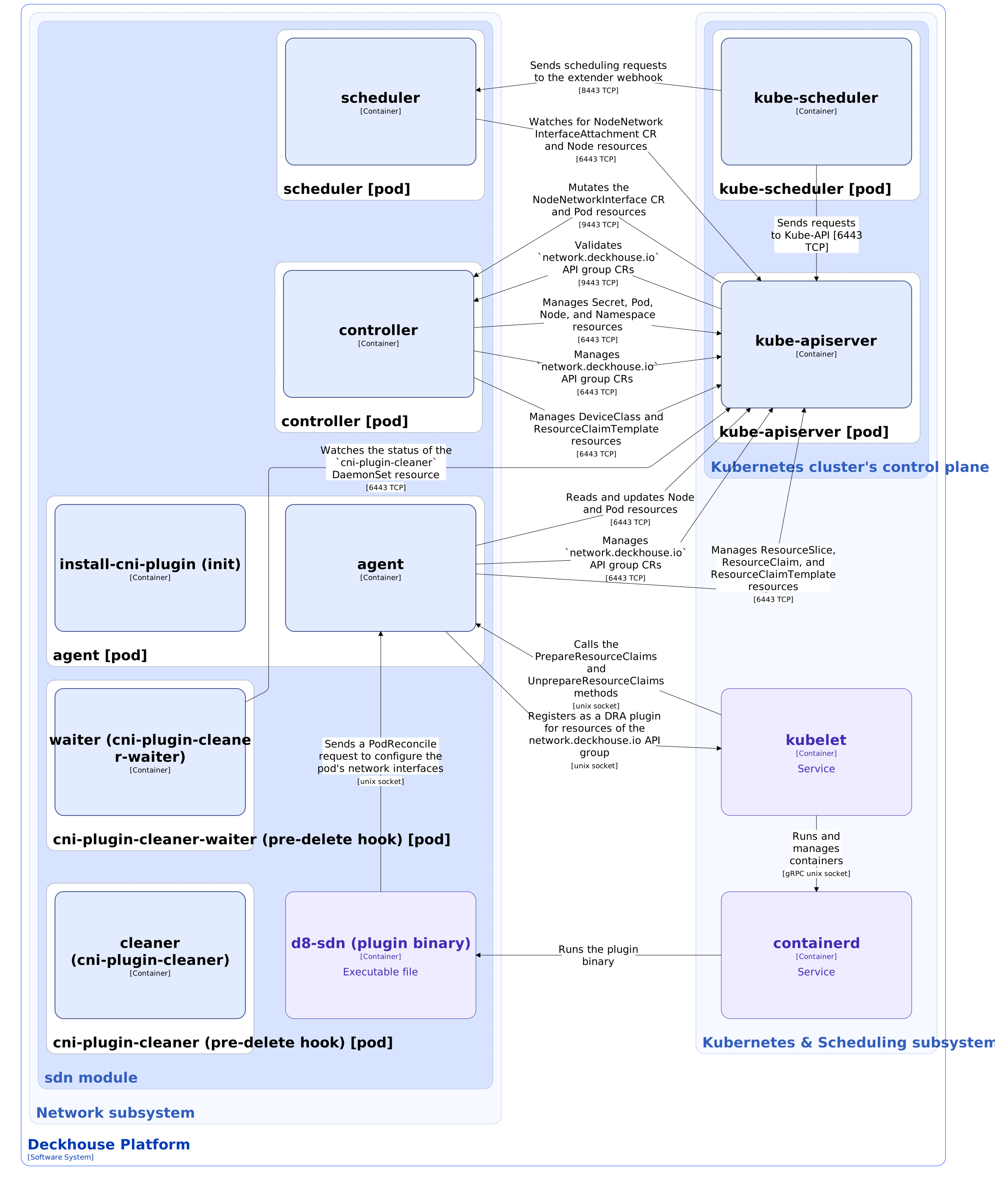
Module components
The module consists of the following components:
-
Controller (Deployment): the controller manages software-defined networks in DP, performing the following actions:
- Manages custom resources of the
network.deckhouse.ioAPI group. - Validates custom resources of the
network.deckhouse.ioAPI group using the Validating Admission Controllers mechanism. - Mutates NodeNetworkInterface custom resources using the Mutating Admission Controllers mechanism.
- Mutates Pod resources in namespaces labeled
direct-nic-access.network.deckhouse.io/enabledto inject a ResourceClaim for hardware network device pass-through.
It consists of a single controller container.
- Manages custom resources of the
-
Agent (DaemonSet): a component that runs on every cluster node and performs the following operations:
- Configures node network interfaces (port bonding, bridging, VLAN interface configuration).
- Brings up additional, underlay, and system networks.
- Implements a CNI server that the d8-sdn component connects to over a Unix socket.
- Implements a Dynamic Resource Allocation (DRA) driver for the
network.deckhouse.ioAPI group, registering itself as a DRA plugin with kubelet, for passing physical and virtual network devices through to a pod. This functionality is available in the DP Ultimate/EE, Certified Core/CSE Lite (1.73), and Certified Pro/CSE Pro (1.73) editions.
The agent translates cluster node and pod configurations into low-level network interface and eBPF program settings that actually process traffic.
It consists of the following containers:
- install-cni-plugin: Init container that copies the
d8-sdnCNI plugin executable to the/opt/cni/bindirectory on the node. - agent: Main container.
The agent component has privileged access to the operating system of each node. On Linux, this requires the following capabilities:
- NET_ADMIN
- SYS_ADMIN
- BPF
The container also runs as the root user (
runAsUser: 0), useshostNetwork: true, and theUnconfinedAppArmor profile. This is required to configure node network interfaces, network namespaces, and to load BPF programs. -
D8-sdn: A CNI plugin executable run by the containerd component according to the CNI specification, for example, ADD when creating a pod’s network namespace and DEL when removing it. D8-sdn communicates with the agent’s API over a Unix socket and triggers the low-level network configuration for pods.
-
Scheduler (Deployment): a kube-scheduler extender that suggests nodes for pod placement according to the pods’ network interface settings.
-
Cni-plugin-cleaner (DaemonSet): a Helm
pre-deletemodule hook, triggered by the Deckhouse controller before thesdnmodule is removed. It runs on every node and deletes the CNI plugin files (the executable in/opt/cni/binand the configuration in/etc/cni/net.d) installed by the agent component. It does not take part in the module’s normal operation. -
Cni-plugin-cleaner-waiter (Job): a Helm
pre-deletemodule hook, triggered by the Deckhouse controller before thesdnmodule is removed, that waits for thecni-plugin-cleanerDaemonSet to finish on every cluster node before Helm is allowed to complete removing the module release.
Module interactions
The module interacts with the following components:
-
Kube-apiserver:
- Manages custom resources of the
network.deckhouse.ioAPI group. - Manages Secret, Pod, Node, Namespace, DeviceClass, ResourceSlice, ResourceClaim, and ResourceClaimTemplate resources.
- Manages custom resources of the
-
Kubelet: Registers itself as a DRA plugin for resources of the
network.deckhouse.ioAPI group.
The following external components interact with the module:
-
Kube-apiserver:
- Validates custom resources of the
network.deckhouse.ioAPI group. - Mutates NodeNetworkInterface and Pod resources.
- Validates custom resources of the
-
Kube-scheduler: Sends requests to the
sdn-scheduler-extenderwebhook for scheduling pods that use software-defined networks. -
Containerd: Runs the d8-sdn executable file with certain commands according to the CNI specification, for example, ADD when creating a pod’s network namespace and DEL when removing it.
-
Kubelet: Calls the
PrepareResourceClaimsandUnprepareResourceClaimsRPC-methods to configure a pod’s DRA resources.